
Hydrothermal liquefaction (HTL) is an advanced thermochemical conversion technology that transforms wet biomass into energy-dense biocrude oil under high-temperature and high-pressure water conditions. Unlike pyrolysis and gasification, HTL eliminates the need for energy-intensive feedstock drying by directly processing high-moisture biomass such as algae, sewage sludge, food waste, animal manure, and other organic residues. This makes it an efficient pathway for valorizing waste streams while reducing overall processing costs. Driven by growing demand for sustainable fuels and circular bioeconomy solutions, ongoing advancements in reactor design, catalysts, continuous-flow systems, and biocrude upgrading are improving HTL’s commercial viability, positioning it as a promising technology for producing renewable transportation fuels, sustainable aviation fuel (SAF), marine fuels, and bio-based chemicals. The following will be covered in the upcoming sections.
- The Science Behind Hydrothermal Liquefaction
- Hydrothermal Liquefaction Process
- Feedstock Options
- Key Operating Parameters
- Why Hydrothermal Liquefaction is a Promising Biofuel Technology
- Why Hydrothermal Liquefaction Matters
- Commercial Opportunity
- Key Challenges in Commercializing Hydrothermal Liquefaction
- Major Products Produced Through Hydrothermal Liquefaction
- Future Growth Drivers
The Science Behind Hydrothermal Liquefaction (HTL)
Hydrothermal Liquefaction (HTL) is a thermochemical conversion process that transforms wet biomass into an energy-dense liquid known as biocrude oil by exposing it to high temperatures (typically 280–370°C) and high pressures (10–25 MPa) in the presence of water. HTL uses subcritical water as both the reaction medium and solvent. Under these conditions, water exhibits unique physical and chemical properties that accelerate the breakdown of complex organic matter into smaller, energy-rich molecules without the need for prior drying.
The process mimics the natural geological formation of crude oil, where organic matter is converted into hydrocarbons over millions of years under heat and pressure. HTL dramatically accelerates this transformation, achieving similar chemical conversions within minutes. As a result, wet biomass is converted into four primary product streams: biocrude oil, an aqueous phase containing dissolved organics, gaseous products (primarily CO₂), and a small quantity of solid residue (biochar or mineral-rich solids).
How Hydrothermal Liquefaction Works
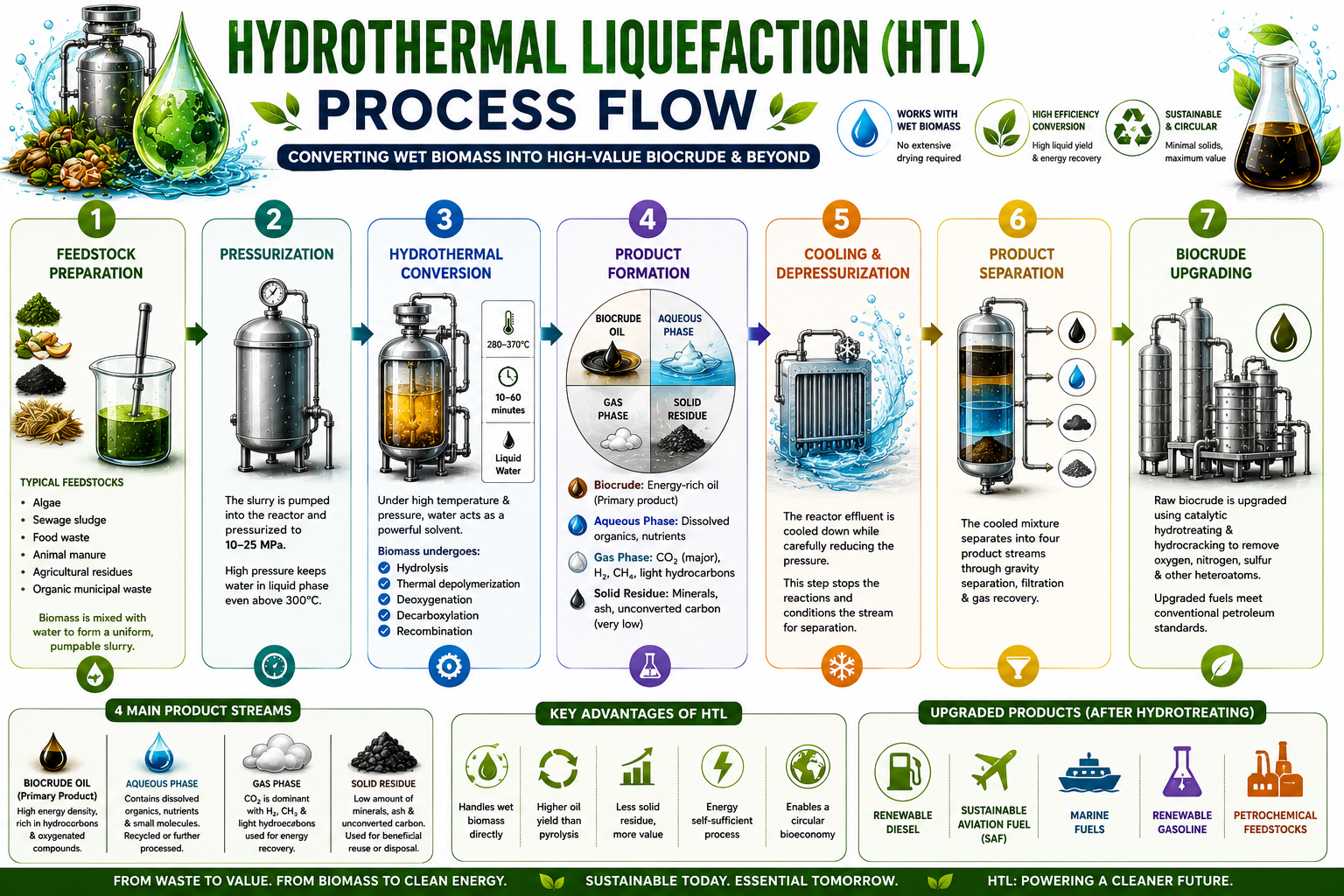
The HTL process consists of a series of interconnected physical and chemical transformations.
1. Feedstock Preparation
Wet biomass is first collected and prepared as a pumpable slurry. Unlike many other thermochemical technologies, extensive drying is unnecessary because water is an integral part of the HTL process.
Typical feedstocks include:
- Algae
- Sewage sludge
- Food waste
- Animal manure
- Agricultural residues
- Organic municipal waste
The biomass is mixed with water to obtain a uniform slurry before entering the reactor.
2. Pressurization
The slurry is pumped into a high-pressure reactor where pressure is increased to approximately 10–25 MPa.
High pressure prevents water from boiling despite temperatures exceeding 300°C, allowing it to remain in the liquid phase and maintain the unique properties required for hydrothermal reactions.
Get in touch
Interested in biochar, bioplastics, biopolymers, or other bio-based business opportunities in India? Get expert guidance from our team
Call Muthu
3. Hydrothermal Conversion
The pressurized slurry is heated to temperatures between 280–370°C.
At these conditions, water behaves very differently from water at ambient conditions. Its dielectric constant decreases, ionic product increases, and solvent properties improve, making it highly effective at dissolving organic compounds and promoting chemical reactions.
Within the reactor, biomass undergoes:
- Hydrolysis
- Thermal depolymerization
- Deoxygenation
- Decarboxylation
- Recombination reactions
These reactions break down large biopolymers into smaller organic molecules that gradually combine to form energy-rich biocrude.
The residence time typically ranges from 10 to 60 minutes, depending on the feedstock and reactor design.
4. Product Formation
As the reaction proceeds, biomass is converted into four distinct product streams.
Biocrude Oil
Hydrophobic organic compounds separate naturally to form a dense liquid rich in hydrocarbons and oxygenated compounds. This is the primary product of HTL.
Aqueous Phase
Water retains dissolved organics, nutrients, and small oxygenated compounds. Depending on the process, this stream may be recycled, treated biologically, or further processed to recover valuable nutrients.
Gas Phase
Carbon dioxide is the dominant gaseous product, with smaller quantities of hydrogen, methane, and light hydrocarbons depending on feedstock composition and operating conditions.
Solid Residue
A small fraction of inorganic minerals, ash, and unconverted carbon remains as solid residue. Compared to pyrolysis, HTL generally produces much less solid char because water promotes more complete conversion of biomass.
5. Cooling and Depressurization
After the desired reaction time, the reactor contents are cooled while maintaining controlled pressure reduction.
This step terminates the chemical reactions and prepares the products for separation.
6. Product Separation
The cooled reaction mixture separates into four product streams through a combination of gravity separation, filtration, and solvent extraction.
- Biocrude is collected for upgrading.
- Aqueous phase is treated or recycled.
- Gases are recovered for energy generation or vented after treatment.
- Solid residue is removed for disposal or beneficial reuse.
7. Biocrude Upgrading
Raw HTL biocrude contains oxygen, nitrogen, sulfur, and other heteroatoms that must be removed before it can be used as transportation fuel.
Commercial upgrading typically involves catalytic hydrotreating and hydrocracking to produce fuels that meet conventional petroleum specifications.
The upgraded products may include:
- Renewable diesel
- Sustainable Aviation Fuel (SAF)
- Marine fuels
- Renewable gasoline
- Petrochemical feedstocks
Feedstock Options
- Algal Biomass – Microalgae and macroalgae
- Sewage Sludge – Municipal and industrial wastewater sludge
- Food Waste – Household and commercial organic waste
- Animal Manure – Cattle, poultry, and swine manure
- Agricultural Residues – Crop residues and agro-industrial waste
- Municipal Organic Waste – Organic fraction of municipal solid waste (OFMSW)
Key Operating Parameters
The performance of HTL depends on several operating conditions.
|
Parameter |
Typical Range |
Influence on Process |
|
Temperature |
280–370°C |
Higher temperatures generally improve conversion but may increase gas formation if excessive. |
|
Pressure |
10–25 MPa |
Maintains water in the liquid phase and promotes hydrothermal reactions. |
|
Residence Time |
10–60 minutes |
Sufficient time ensures effective conversion while minimizing secondary reactions. |
|
Biomass Solids Content |
10–30 wt.% |
Influences reactor throughput, viscosity, and heat transfer. |
|
Feedstock Moisture |
Typically 70–90% |
High moisture is advantageous, eliminating the need for energy-intensive drying. |
|
Catalysts (Optional) |
Alkali salts, metal catalysts |
Can improve biocrude yield, deoxygenation, and product quality depending on the process. |
Hydrothermal Liquefaction as a Wet Biomass Conversion Platform
A major advantage of HTL is its ability to directly process high-moisture biomass that is unsuitable or uneconomical for many other thermochemical technologies. By using water as both the reaction medium and catalyst, HTL efficiently converts diverse feedstocks—including algae, sewage sludge, food waste, and agricultural residues—into energy-dense biocrude with relatively low char formation. This capability, combined with ongoing advances in reactor design and fuel upgrading, positions HTL as one of the most promising technologies for producing renewable liquid fuels from wet organic waste streams
Why Hydrothermal Liquefaction Matters
Hydrothermal Liquefaction (HTL) unlocks the value of wet biomass by eliminating the need for energy-intensive drying, making it one of the most efficient pathways for converting high-moisture feedstocks into renewable fuels.
- Directly converts wet biomass into energy-dense biocrude, reducing preprocessing costs.
- Processes feedstocks that are difficult to utilize through conventional thermochemical technologies, such as sewage sludge, algae, and food waste.
- Produces renewable fuels compatible with existing refinery infrastructure after upgrading.
- Supports waste management and resource recovery by valorizing organic waste streams that would otherwise require disposal.
- Recovers valuable nutrients from process water, contributing to a circular bioeconomy.
- Expands the range of usable biomass resources, increasing flexibility for future biorefineries.
Commercial Opportunity
Growing interest in renewable fuels and sustainable waste management is positioning HTL as a promising technology for converting wet biomass into high-value energy products.
- Increasing volumes of sewage sludge, food waste, and organic municipal waste provide abundant low-cost feedstocks.
- Rising demand for Sustainable Aviation Fuel (SAF) and renewable diesel is driving investment in biocrude upgrading technologies.
- Municipalities and wastewater utilities are exploring HTL to reduce waste disposal costs while recovering energy and nutrients.
- Integration with existing petroleum refineries creates opportunities to process upgraded biocrude using established infrastructure.
- Growing emphasis on circular waste management is encouraging investment in technologies that recover both energy and valuable resources.
- Government support for advanced biofuels and waste-to-energy projects is accelerating pilot and demonstration-scale deployment.
Key Challenges in Commercializing Hydrothermal Liquefaction (HTL)
- High Capital Investment
HTL requires high-pressure reactors, specialized equipment, and corrosion-resistant materials, resulting in significantly higher capital costs than many other biomass conversion technologies. - Continuous Reactor Operation
Maintaining stable, continuous processing of wet biomass slurries under high pressure remains a major engineering challenge for commercial-scale plants. - Biocrude Upgrading
HTL-derived biocrude contains oxygen, nitrogen, and other impurities that require catalytic upgrading before it can be used as transportation fuel. - Aqueous Phase Treatment
The process generates nutrient-rich wastewater that requires additional treatment or resource recovery to minimize environmental impact. - Feedstock Variability
Differences in moisture, ash, lipid, and protein content among feedstocks can significantly affect biocrude yield, quality, and process performance. - Energy Efficiency and Heat Recovery
HTL is energy-intensive, making efficient heat integration and recovery essential for improving overall process economics and sustainability. - Commercial Scale-Up and Investment
Although technically proven, HTL requires further demonstration, investment, and supportive policies to achieve widespread commercial deployment.
Major Products Produced Through Hydrothermal Liquefaction (HTL)
|
End Product |
Typical Feedstock |
Primary Market |
|
Renewable Diesel |
Algae, sewage sludge, food waste, agricultural residues |
Road transport, heavy vehicles |
|
Sustainable Aviation Fuel (SAF) |
Wet biomass, algae, food waste |
Aviation |
|
Marine Fuels |
Municipal sludge, algae, wet organic waste |
Shipping and marine transport |
|
Renewable Chemicals |
Wet biomass-derived biocrude |
Petrochemicals, plastics, specialty chemicals |
|
Nutrient Recovery Products |
Sewage sludge, manure, food waste |
Agriculture and fertilizer industry |
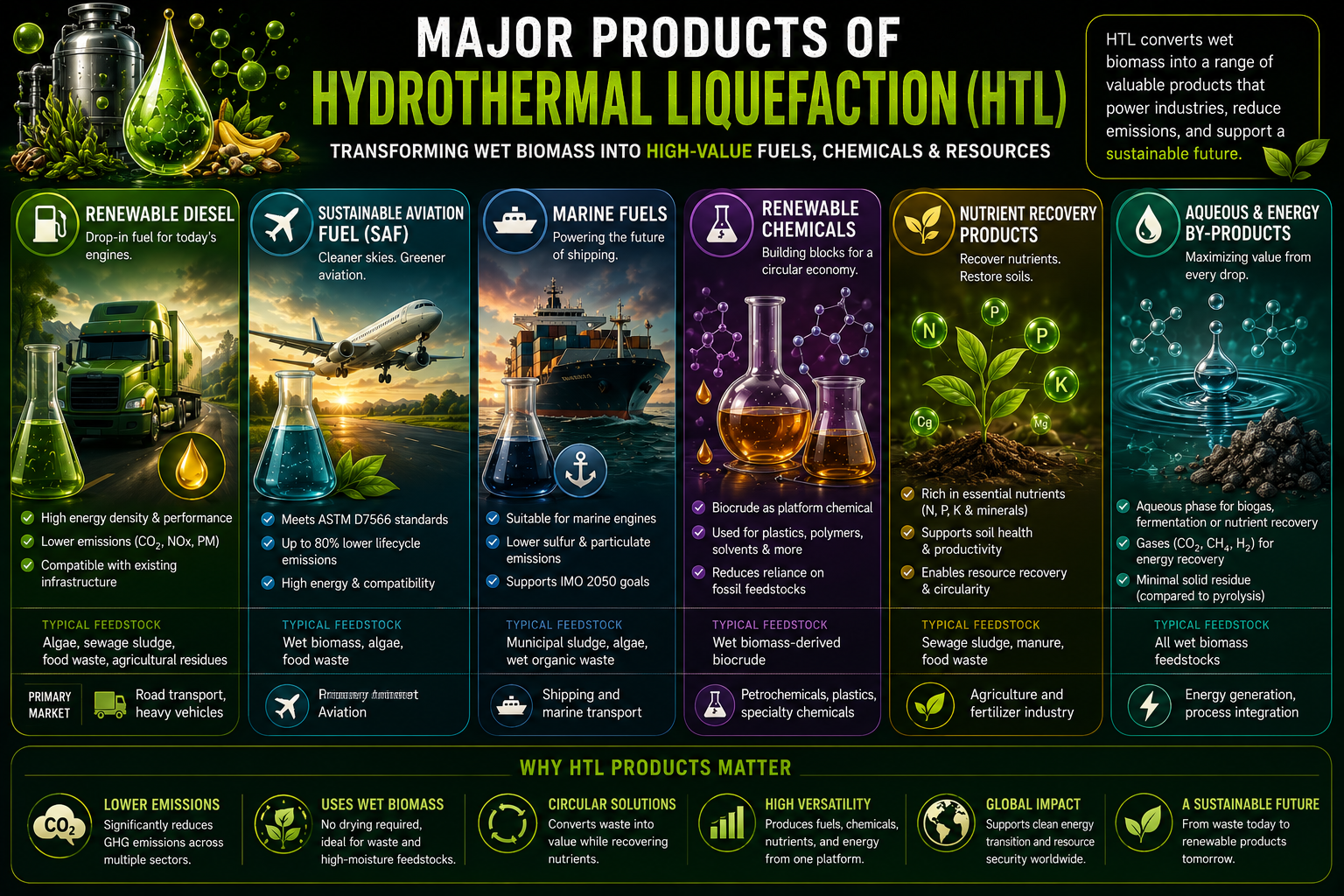
1. Renewable Diesel
Feedstock: Algae, sewage sludge, food waste, agricultural residues
Process: Wet Biomass → HTL → Biocrude → Hydrotreating → Renewable Diesel
Renewable diesel is the most commercially attractive product derived from HTL. The biocrude produced during liquefaction is catalytically upgraded into a high-quality diesel fuel that is chemically similar to petroleum diesel. It can be used as a drop-in fuel without modifications to existing engines or fuel infrastructure.
Key Applications: Heavy-duty transport, buses, freight, construction equipment, marine vessels
2. Sustainable Aviation Fuel (SAF)
Feedstock: Algae, food waste, sewage sludge, forestry residues
Process: HTL → Biocrude → Hydroprocessing → Sustainable Aviation Fuel
HTL-derived biocrude can be upgraded into Sustainable Aviation Fuel (SAF), one of the fastest-growing renewable fuel markets. Due to its high energy density and compatibility with existing aircraft engines, HTL-based SAF is considered a promising pathway for reducing aviation-related carbon emissions.
Key Applications: Commercial aviation, cargo aircraft, military aviation
3. Marine Fuels
Feedstock: Wet organic waste, algae, municipal sludge
Process: HTL → Biocrude → Refining → Marine Fuel
The maritime sector is increasingly exploring renewable marine fuels to comply with stricter emissions regulations. HTL-derived fuels offer a sustainable alternative for ships while utilizing difficult-to-manage wet biomass and waste streams.
Key Applications: Cargo ships, tankers, offshore vessels, fishing fleets
4. Renewable Chemicals and Petrochemical Feedstocks
Feedstock: Diverse wet biomass
Process: HTL → Biocrude → Fractionation & Catalytic Upgrading
Beyond transportation fuels, HTL biocrude serves as a renewable feedstock for the chemical industry. After refining, it can be converted into aromatic compounds, phenols, hydrocarbons, and other intermediates used in the manufacture of plastics, resins, solvents, and specialty chemicals.
Examples of Products:
- Phenolic compounds
- Aromatic hydrocarbons
- Naphtha-range hydrocarbons
- Chemical intermediates
Key Applications: Petrochemicals, plastics, coatings, industrial chemicals
5. Nutrient Recovery Products
Feedstock: Sewage sludge, manure, food waste
Process: HTL → Aqueous Phase → Nutrient Recovery
The aqueous phase generated during HTL contains significant quantities of nitrogen, phosphorus, and potassium. Rather than treating these nutrients as waste, modern HTL systems increasingly recover them for reuse in fertilizers or recycle them within integrated biorefinery operations.
Key Applications: Fertilizer production, nutrient recycling, circular agriculture
Future Growth Drivers
The future growth of HTL will be driven by the increasing need to utilize wet biomass efficiently while producing low-carbon fuels and recovering valuable resources.
- Expansion of wet biomass feedstock availability, particularly sewage sludge, algae, and food waste, will strengthen the technology’s commercial potential.
- Growing demand for renewable diesel and Sustainable Aviation Fuel (SAF) will increase the value of HTL-derived biocrude.
- Advances in catalytic upgrading and refinery integration will improve fuel quality while reducing production costs.
- Improved heat recovery and continuous reactor technologies will enhance process efficiency and economic viability.
- Increasing focus on nutrient recovery and circular resource utilization will create additional value beyond fuel production.
- Supportive policies for waste valorization, carbon reduction, and advanced biofuels will play a key role in accelerating commercial-scale adoption.