Fischer–Tropsch (FT) synthesis is a catalytic fuel production technology that converts synthesis gas (syngas)—a mixture of carbon monoxide (CO) and hydrogen (H₂)—into liquid hydrocarbons that can be refined into diesel, sustainable aviation fuel (SAF), gasoline, waxes, and specialty chemicals. Unlike biological or thermochemical conversion processes that directly process biomass, FT synthesis is a downstream conversion technology that upgrades syngas into high-value, low-sulfur transportation fuels with properties comparable to conventional petroleum products. The following will be covered in the upcoming sections.
- The Chemistry Behind Fischer Tropsch
- Fischer Tropsch Process
- Feedstock Utilization
- Factors Affecting Product Yield
- Why Fischer Tropsch is the Preferred Fuel synthesis Technology
- Why Fischer Tropsch Matters
- Commercial Opportunity
- Key Challenges in Commercializing Fischer Tropsch
- Major Products Produced Through Fischer Tropsch
- Future Growth Drivers
The Chemistry Behind Fischer–Tropsch Synthesis
Fischer–Tropsch (FT) synthesis is a catalytic chemical process in which carbon monoxide (CO) and hydrogen (H₂) react over a metal catalyst to produce long-chain hydrocarbons and water. These hydrocarbons can subsequently be upgraded into renewable diesel, Sustainable Aviation Fuel (SAF), gasoline, lubricants, waxes, and specialty chemicals.
FT synthesis first requires the production of syngas, typically through gasification of biomass, municipal solid waste, coal, or natural gas. The syngas then undergoes catalytic synthesis under carefully controlled conditions to produce liquid fuels.
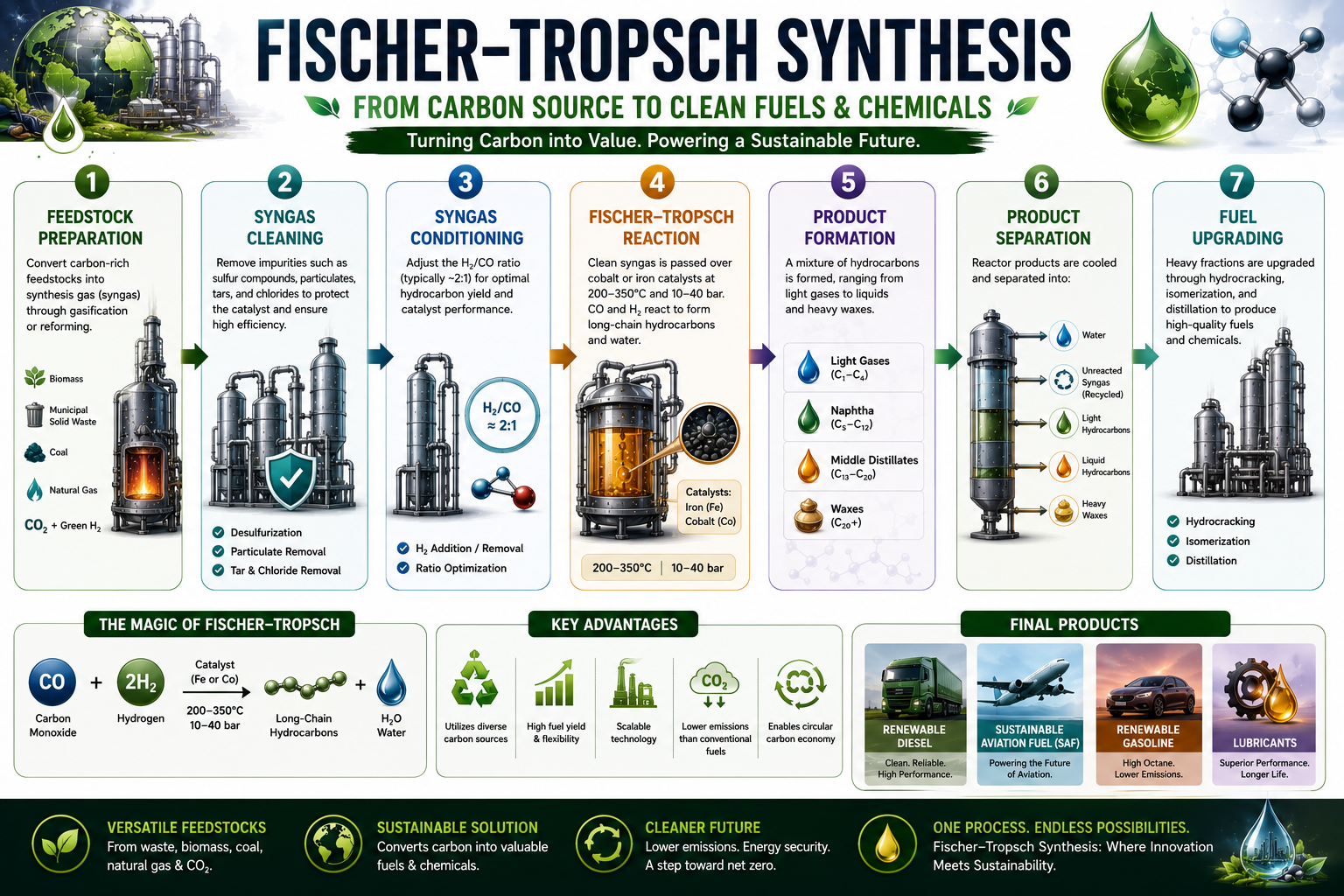
How Fischer–Tropsch Synthesis Works
1. Feedstock Preparation
The process begins by converting carbon-rich feedstocks such as biomass, municipal solid waste, coal, natural gas, or captured CO₂ (with green hydrogen) into synthesis gas (syngas) through gasification or reforming.
2. Syngas Cleaning
The produced syngas is purified to remove contaminants such as sulfur compounds, particulates, tars, and chlorides, which can deactivate the catalyst and reduce process efficiency.
3. Syngas Conditioning
The hydrogen-to-carbon monoxide (H₂/CO) ratio is adjusted to the desired level (typically around 2:1) to maximize hydrocarbon production and catalyst performance.
Get in touch
Interested in biochar, bioplastics, biopolymers, or other bio-based business opportunities in India? Get expert guidance from our team
Call Muthu
4. Fischer–Tropsch Reaction
The cleaned syngas is passed through a reactor containing cobalt or iron catalysts at 200–350°C and 10–40 bar. Carbon monoxide and hydrogen react on the catalyst surface to form long-chain hydrocarbons and water.
5. Product Formation
The reaction produces a mixture of hydrocarbons ranging from light gases to liquid fuels and heavy waxes. The exact product distribution depends on the catalyst and operating conditions.
6. Product Separation
The reactor products are cooled and separated into:
- Water
- Unreacted syngas (recycled)
- Light hydrocarbons
- Liquid hydrocarbons
- Heavy waxes
7. Fuel Upgrading
The heavier hydrocarbon fractions are upgraded through hydrocracking, isomerization, and distillation to produce high-quality fuels and chemicals.
Final Products
The upgraded products include:
- Renewable Diesel
- Sustainable Aviation Fuel (SAF)
- Renewable Gasoline
- Lubricants
Feedstock Options
- Forestry Residues – Wood chips, sawdust, bark, logging residues
- Agricultural Residues – Rice straw, wheat straw, corn stover, sugarcane bagasse
- Municipal Solid Waste (MSW) – Organic and combustible waste fractions
- Natural Gas – Via steam methane reforming to produce syngas
- Coal – Via coal gasification (conventional FT route)
- Green Hydrogen + Captured CO₂ – Power-to-Liquids (PtL) pathway for synthetic fuels
Factors Affecting Product Yield
|
Parameter |
Typical Range |
Influence on Products |
|
Reaction Temperature |
200–350°C |
Lower temperatures favor diesel and waxes, while higher temperatures increase gasoline-range hydrocarbons and light gases. |
|
Pressure |
10–40 bar |
Higher pressures generally increase liquid hydrocarbon yields and overall conversion efficiency. |
|
H₂/CO Ratio |
1.8–2.2 |
An optimum ratio maximizes hydrocarbon production and catalyst performance. |
|
Catalyst Type |
Iron or Cobalt |
Cobalt favors long-chain paraffins and diesel, while iron is better suited for biomass-derived syngas and promotes the water-gas shift reaction. |
|
Residence Time |
Seconds to minutes |
Longer residence times increase syngas conversion but may also promote secondary reactions. |
|
Syngas Purity |
Very low sulfur, tar, and particulates |
Cleaner syngas improves catalyst life, conversion efficiency, and product quality. |
|
Catalyst Particle Size & Activity |
Process dependent |
Higher catalyst activity improves reaction rates, selectivity, and fuel yield. |
Why Fischer–Tropsch Synthesis is the Preferred Fuel Synthesis Technology
Fischer–Tropsch synthesis is widely preferred because it converts syngas from diverse feedstocks into high-quality, sulfur-free liquid fuels that are fully compatible with existing engines and fuel infrastructure. Its feedstock flexibility, ability to produce drop-in fuels such as renewable diesel and Sustainable Aviation Fuel (SAF), and compatibility with biomass, municipal waste, and green hydrogen make it one of the most versatile and future-ready fuel synthesis technologies.
Why Fischer–Tropsch Synthesis Matters
Fischer–Tropsch (FT) synthesis is a cornerstone technology for producing high-quality synthetic fuels from renewable and low-carbon carbon sources. By converting syngas into liquid hydrocarbons, it bridges the gap between biomass conversion and drop-in transportation fuels.
- Converts syngas into premium liquid fuels compatible with existing engines and fuel infrastructure.
- Supports multiple feedstocks, including biomass, municipal waste, natural gas, and captured CO₂ with green hydrogen.
- Produces sulfur-free, high-quality fuels with excellent combustion properties and low emissions.
- Enables the production of Sustainable Aviation Fuel (SAF), renewable diesel, and renewable gasoline from renewable carbon sources.
- Integrates with gasification and carbon capture technologies, supporting the transition to a low-carbon energy system.
- Provides a scalable pathway for decarbonizing hard-to-electrify sectors, particularly aviation and heavy transport.
Commercial Opportunity
Global efforts to decarbonize transportation and reduce reliance on fossil fuels are driving renewed investment in Fischer–Tropsch technology.
- Rapid growth in Sustainable Aviation Fuel (SAF) is creating strong demand for FT-based fuel production.
- Increasing investments in biomass-to-liquids (BtL) and Power-to-Liquids (PtL) projects are expanding commercial deployment.
- Growing availability of biomass-derived syngas and green hydrogen is strengthening the renewable feedstock base.
- Industrial decarbonization strategies are encouraging the production of synthetic fuels for sectors with limited alternatives.
- Integration with existing refinery infrastructure reduces barriers to commercialization and fuel distribution.
- Government incentives and net-zero commitments continue to support investment in advanced synthetic fuel technologies.
Key Challenges in Commercializing Fischer–Tropsch Synthesis
- High Capital Investment
FT plants require gasifiers, syngas cleaning units, reactors, and fuel upgrading systems, resulting in high capital and infrastructure costs. - Syngas Production and Purification
Producing clean syngas with the correct hydrogen-to-carbon monoxide ratio is energy-intensive and essential for efficient catalyst performance. - Catalyst Cost and Deactivation
FT catalysts are expensive and can lose activity due to impurities such as sulfur, chlorine, and particulates present in the syngas. - Energy-Intensive Process
Multiple processing steps—including gasification, syngas conditioning, FT synthesis, and fuel upgrading—increase overall energy demand. - Process Integration and Scale-Up
Efficient integration of gasification, synthesis, heat recovery, and upgrading remains a significant engineering challenge at commercial scale. - Economic Competitiveness
FT fuels must compete with conventional petroleum fuels, requiring lower production costs, improved process efficiency, and supportive carbon pricing or renewable fuel incentives. - Policy and Feedstock Availability
Long-term commercialization depends on reliable biomass or low-carbon feedstock supplies, stable regulations, and policies supporting sustainable fuel production.
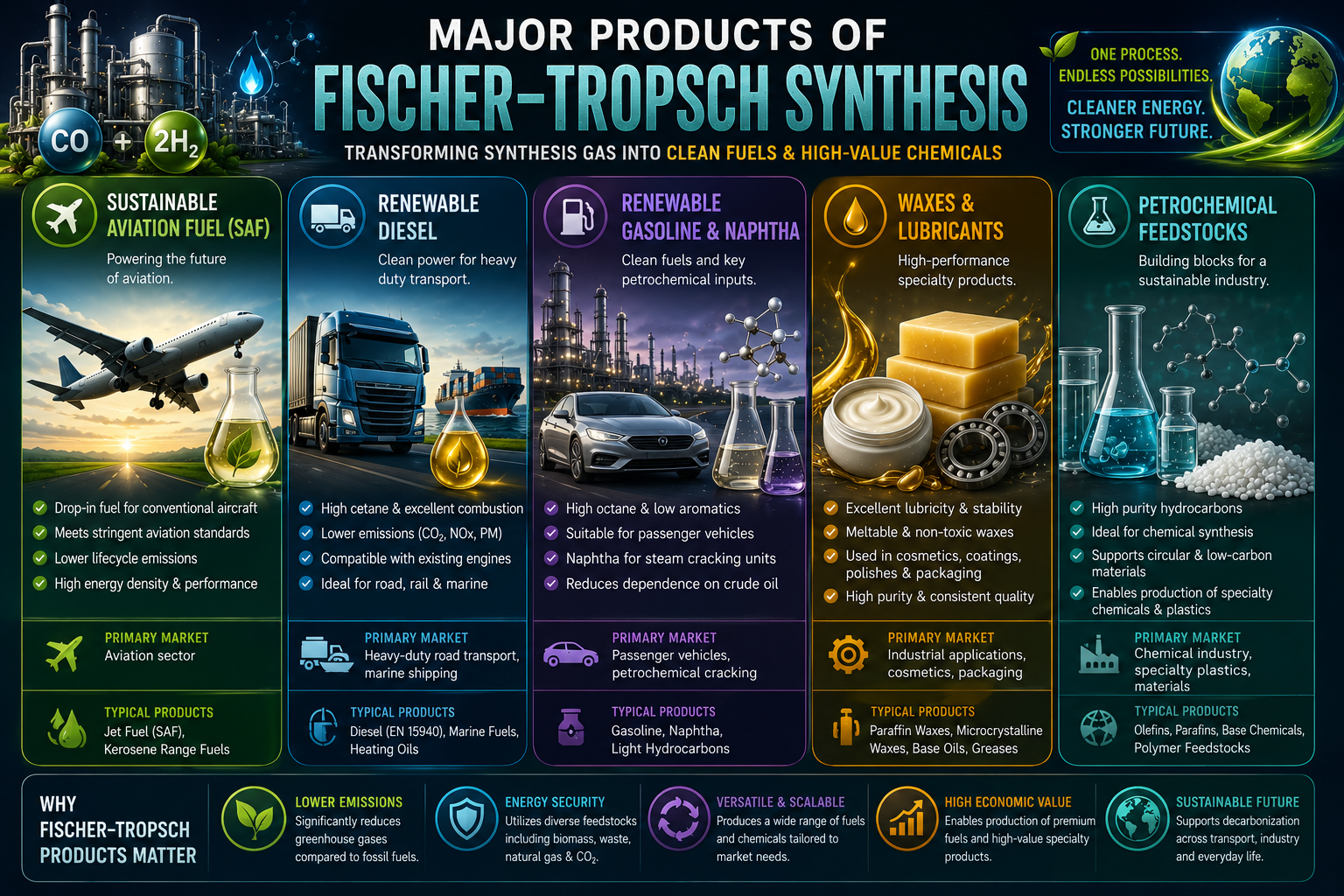
Major Products Produced Through Fischer–Tropsch Synthesis
End Product |
Primary Market |
Sustainable Aviation Fuel (SAF) |
Aviation sector |
Renewable Diesel |
Heavy-duty road transport, marine shipping |
Renewable Gasoline & Naphtha |
Passenger vehicles, petrochemical cracking |
Waxes & Lubricants |
Industrial applications, cosmetics, packaging |
Petrochemical Feedstocks |
Chemical industry, specialty plastics, materials |
1. Sustainable Aviation Fuel (SAF)
Process: Syngas → FT Synthesis → Hydroprocessing → SAF
Fischer–Tropsch synthesis is one of the leading pathways for producing drop-in Sustainable Aviation Fuel that meets stringent aviation fuel standards.
Key Applications: Commercial aviation, cargo aircraft, military aviation
2. Renewable Diesel
Feedstock: Biomass, forestry residues, agricultural residues
Process: Syngas → FT Synthesis → Diesel Fraction → Upgrading
FT renewable diesel is a high-quality, sulfur-free fuel with excellent cetane number and full compatibility with existing diesel engines.
Key Applications: Heavy-duty transport, buses, trucks, mining and construction equipment
3. Renewable Gasoline and Naphtha
Process: FT Synthesis → Light Hydrocarbon Fraction → Refining
The lighter hydrocarbon fractions produced during FT synthesis are upgraded into renewable gasoline and naphtha, which can be blended with conventional fuels or used as petrochemical feedstocks.
Key Applications: Passenger vehicles, petrochemical industry
4. Waxes and Lubricants
Process: FT Synthesis → Heavy Hydrocarbon Fraction → Refining
Heavy hydrocarbons produced during FT synthesis are processed into high-purity waxes and specialty lubricants used in numerous industrial applications.
Key Applications: Candles, coatings, packaging, cosmetics, industrial lubricants
5. Petrochemical Feedstocks
Feedstock: Biomass, municipal waste, natural gas-derived syngas
Process: FT Synthesis → Hydrocarbon Intermediates → Chemical Processing
Fischer–Tropsch hydrocarbons serve as renewable feedstocks for manufacturing plastics, solvents, synthetic materials, and specialty chemicals.
Key Applications: Petrochemicals, polymers, specialty chemicals
Future Growth Drivers
The future of Fischer–Tropsch synthesis will be shaped by the expanding availability of low-carbon syngas and the increasing demand for sustainable transportation fuels.
- Growing production of green hydrogen will accelerate renewable fuel production through Power-to-Liquids (PtL) pathways.
- Increasing deployment of biomass gasification and waste gasification will expand the supply of renewable syngas.
- Rising global demand for Sustainable Aviation Fuel (SAF) will remain one of the strongest drivers of FT commercialization.
- Advances in catalyst development and reactor design will improve conversion efficiency, fuel selectivity, and process economics.
- Carbon capture and utilization (CCU) will enable greater use of captured CO₂ as a renewable carbon source.
- Long-term decarbonization policies and carbon pricing mechanisms will improve the competitiveness of synthetic fuels against conventional petroleum products.