Anaerobic digestion (AD) is a biological conversion technology that breaks down organic matter in the absence of oxygen to produce biogas—a renewable mixture primarily composed of methane and carbon dioxide—and a nutrient-rich residue known as digestate. Using naturally occurring microorganisms, the process converts a wide range of organic feedstocks, including agricultural residues, animal manure, food waste, sewage sludge, and municipal organic waste, into renewable energy and valuable biofertilizers. The following will be covered in upcoming sections.
- The Science Behind Anaerobic digestion
- Anaerobic digestion Process
- Feedstock Utilization
- Factors Affecting Product Yield
- Why Anaerobic Digestion Matters
- Commercial Opportunity
- Key Challenges in Commercializing Anaerobic digestion
- Major Products Produced Through Anaerobic digestion
- Future Growth Drivers
The Science Behind Anaerobic Digestion
Anaerobic digestion (AD) is a biological conversion process in which microorganisms break down organic matter in the absence of oxygen to produce biogas and a nutrient-rich residue known as digestate. Unlike thermochemical technologies such as pyrolysis or hydrothermal liquefaction, anaerobic digestion relies entirely on naturally occurring microbial communities that convert complex organic materials into methane through a series of biological reactions.
The process occurs under controlled conditions inside an airtight digester, where different groups of microorganisms work together in sequence. Each microbial group performs a specific function, gradually converting complex organic compounds into simpler molecules until the final product—methane—is formed. The primary products of anaerobic digestion are biogas (typically 50–70% methane and 30–50% carbon dioxide) and digestate, which can be used as an organic fertilizer.
Organic waste is primarily composed of:
- Carbohydrates
- Proteins
- Lipids (Fats & Oils)
- Organic Fibers
These complex compounds cannot be converted directly into methane. Instead, they pass through four sequential biological stages, each carried out by specialized microorganisms.
1. Hydrolysis
Hydrolytic bacteria produce enzymes that break down large organic molecules into smaller, soluble compounds.
- Carbohydrates → Simple sugars
- Proteins → Amino acids
- Lipids → Fatty acids and glycerol
Hydrolysis is often the rate-limiting step, particularly for lignocellulosic biomass.
2. Acidogenesis
Acidogenic bacteria convert the soluble compounds into:
- Volatile fatty acids (VFAs)
- Alcohols
- Hydrogen (H₂)
- Carbon dioxide (CO₂)
These products serve as intermediates for the next stage.
3. Acetogenesis
Acetogenic bacteria further convert volatile fatty acids and alcohols into:
- Acetate
- Hydrogen
- Carbon dioxide
Acetate is the primary precursor for methane production.
Get in touch
Interested in biochar, bioplastics, biopolymers, or other bio-based business opportunities in India? Get expert guidance from our team
Call Muthu
4. Methanogenesis
Methanogenic archaea convert acetate, hydrogen, and carbon dioxide into methane.
Two major pathways occur:
- Acetoclastic Methanogenesis: Acetate → Methane + CO₂
- Hydrogenotrophic Methanogenesis: CO₂ + H₂ → Methane + Water
This final stage produces the methane-rich biogas that can be used as a renewable energy source.
How Anaerobic Digestion Works
The anaerobic digestion process consists of several interconnected biological and engineering steps.
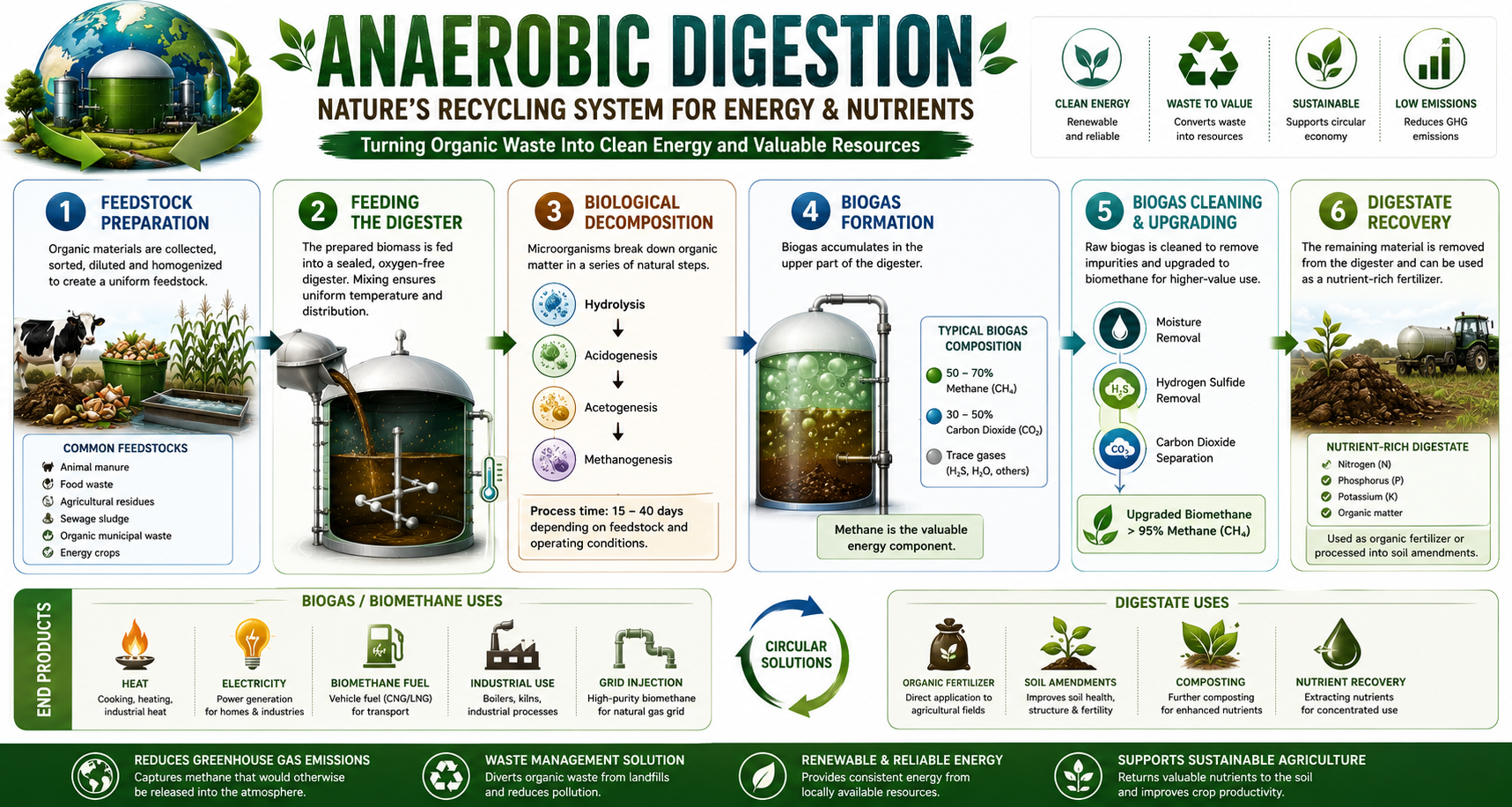
1. Feedstock Preparation
Organic materials are collected, sorted, and mixed to create a uniform feedstock suitable for digestion.
Common feedstocks include:
- Animal manure
- Food waste
- Agricultural residues
- Sewage sludge
- Organic municipal waste
- Energy crops
The feedstock is often diluted and homogenized to facilitate pumping and microbial activity.
2. Feeding the Digester
The prepared biomass is introduced into a sealed, oxygen-free digester.
Mechanical mixing ensures uniform distribution of microorganisms, nutrients, and heat throughout the reactor.
3. Biological Decomposition
Inside the digester, microorganisms sequentially carry out:
- Hydrolysis
- Acidogenesis
- Acetogenesis
- Methanogenesis
These reactions gradually convert organic matter into methane-rich biogas.
The digestion process typically requires 15–40 days, depending on the feedstock and operating conditions.
4. Biogas Formation
As microorganisms decompose the biomass, biogas accumulates in the upper portion of the digester.
Typical composition:
- Methane (CH₄): 50–70%
- Carbon Dioxide (CO₂): 30–50%
- Small amounts of hydrogen sulfide, water vapor, and trace gases
Methane is the valuable energy component of biogas.
5. Biogas Cleaning and Upgrading
Raw biogas contains impurities such as hydrogen sulfide, moisture, and carbon dioxide.
Depending on the intended application, the gas may undergo:
- Moisture removal
- Hydrogen sulfide removal
- Carbon dioxide separation
After upgrading, the product is known as biomethane, with methane concentrations exceeding 95%.
6. Digestate Recovery
After digestion is complete, the remaining material is removed from the digester.
Digestate contains valuable nutrients including:
- Nitrogen
- Phosphorus
- Potassium
- Organic matter
It can be applied directly as an organic fertilizer or further processed into soil amendments.
Feedstock Options
- Animal Manure – Cattle, poultry, swine, and dairy manure
- Food Waste – Household, commercial, and industrial food waste
- Agricultural Residues – Crop residues, silage, and agro-industrial waste
- Sewage Sludge – Municipal and industrial wastewater sludge
- Municipal Organic Waste – Organic fraction of municipal solid waste (OFMSW)
- Energy Crops – Maize silage, sorghum, grass, and other dedicated energy crops
- Industrial Organic Waste – Dairy waste, brewery spent grains, distillery waste, and food processing residues
Key Operating Parameters
|
Parameter |
Typical Range |
Influence on Process |
|
Temperature |
35–40°C (Mesophilic) or 50–55°C (Thermophilic) |
Higher temperatures increase reaction rates but require greater energy input. |
|
pH |
6.8–7.5 |
Neutral pH supports healthy microbial activity and stable methane production. |
|
Hydraulic Retention Time |
15–40 days |
Longer retention times improve organic matter degradation and methane yield. |
|
Organic Loading Rate |
Feedstock dependent |
Excessive loading can inhibit microbial activity and reduce process stability. |
|
Carbon-to-Nitrogen Ratio (C/N) |
20:1–30:1 |
Balanced nutrient availability promotes efficient microbial growth and methane production. |
|
Mixing |
Continuous or intermittent |
Prevents settling, improves heat transfer, and ensures uniform microbial distribution. |
Why Anaerobic Digestion Matters
Anaerobic digestion is one of the few technologies that simultaneously addresses renewable energy generation, organic waste management, and nutrient recovery, making it a cornerstone of the circular bioeconomy.
-
Converts organic waste into renewable biogas, reducing dependence on fossil natural gas.
-
Transforms agricultural, municipal, and industrial wastes into valuable resources, minimizing landfill disposal and methane emissions.
-
Produces nutrient-rich digestate, reducing the need for synthetic fertilizers and supporting sustainable agriculture.
-
Supports decentralized renewable energy production, particularly in rural and agricultural communities.
-
Reduces greenhouse gas emissions by capturing methane that would otherwise be released from unmanaged organic waste.
-
Promotes circular resource utilization by recovering both energy and nutrients from a wide range of organic feedstocks.
Commercial Opportunity
Growing demand for renewable gas and sustainable waste management is driving the expansion of anaerobic digestion across the energy, agriculture, and municipal sectors.
-
Increasing volumes of food waste, livestock manure, and sewage sludge provide abundant feedstocks for biogas production.
-
Rising demand for biomethane is creating opportunities for renewable gas injection into existing natural gas networks.
-
Expansion of waste-to-energy initiatives is encouraging municipalities and industries to adopt anaerobic digestion.
-
Growing markets for organic fertilizers are increasing the value of digestate as a commercial co-product.
-
Carbon credit mechanisms and methane reduction initiatives are improving the financial viability of anaerobic digestion projects.
-
Government incentives for renewable energy and waste management continue to support commercial deployment worldwide.
Key Challenges in Commercializing Anaerobic Digestion
- Feedstock Availability and Consistency
Seasonal availability and variations in the composition of organic waste can affect biogas yield and process stability. - Process Stability
Maintaining optimal temperature, pH, nutrient balance, and microbial activity is essential for stable methane production and efficient digestion. - Biogas Purification and Upgrading
Raw biogas contains carbon dioxide, hydrogen sulfide, and moisture that must be removed before it can be used as biomethane or injected into gas grids. - Digestate Management
Efficient handling, storage, and utilization of digestate are necessary to maximize nutrient recovery while minimizing environmental impacts. - High Initial Investment
Commercial AD plants require significant capital for digesters, gas upgrading systems, feedstock handling, and storage infrastructure. - Economic Competitiveness
The profitability of AD projects depends on feedstock costs, energy prices, biogas utilization pathways, and revenues from digestate and carbon credits. - Policy and Infrastructure Support
Wider adoption requires supportive regulations, renewable energy incentives, efficient waste collection systems, and infrastructure for biomethane distribution and utilization.
Major Products Produced Through Anaerobic Digestion
|
End Product |
Typical Feedstock |
Primary Market |
|
Biogas |
Food waste, manure, sewage sludge, agricultural residues |
Renewable energy |
|
Biomethane |
Upgraded biogas |
Transportation, natural gas grids |
|
Organic Fertilizer (Digestate) |
Digested organic biomass |
Agriculture, soil improvement |
|
Electricity & Heat |
Biogas |
Power generation, industrial heating |
|
Nutrient Recovery Products |
Digestate |
Fertilizer industry, circular agriculture |
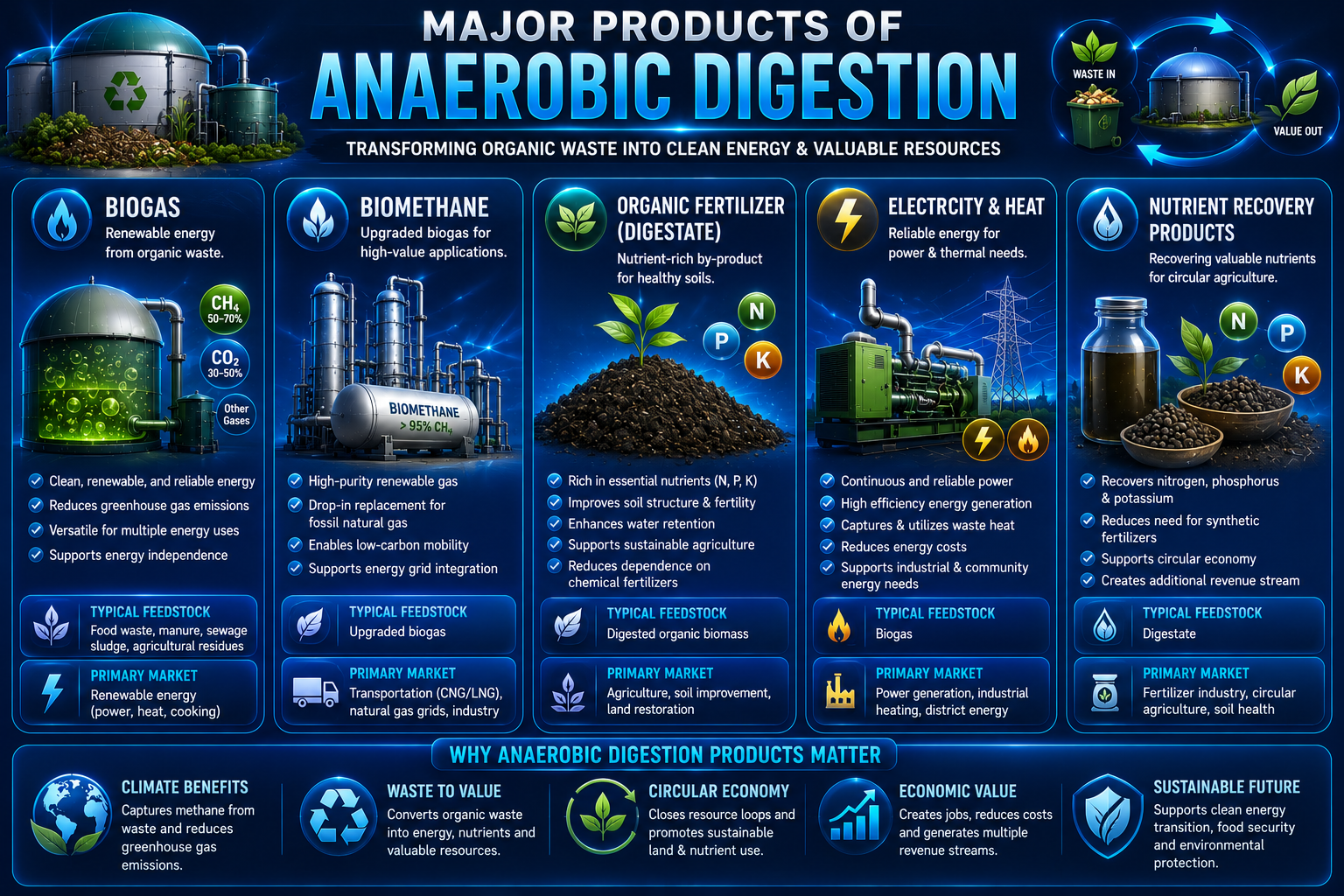
1. Biogas
Feedstock: Animal manure, food waste, sewage sludge, agricultural residues
Process: Organic Waste → Anaerobic Digestion → Biogas
Biogas is the primary product of anaerobic digestion, consisting mainly of methane (CH₄) and carbon dioxide (CO₂). It can be used directly for heat and electricity generation or upgraded into biomethane.
Key Applications: Combined heat and power (CHP), cooking, industrial heating, electricity generation
2. Biomethane
Feedstock: Upgraded biogas
Process: Biogas → CO₂ & Impurity Removal → Biomethane
After purification and upgrading, biogas becomes biomethane containing more than 95% methane. Biomethane has properties similar to natural gas and can be injected into gas grids or used as a transportation fuel.
Key Applications: Vehicle fuel, natural gas grids, industrial fuel, residential energy
3. Organic Fertilizer (Digestate)
Feedstock: Residue from anaerobic digestion
Process: Anaerobic Digestion → Digestate → Solid/Liquid Separation
Digestate is a nutrient-rich by-product containing nitrogen, phosphorus, potassium, and organic matter. It is widely used as an organic fertilizer and soil conditioner, reducing the need for synthetic fertilizers.
Key Applications: Agriculture, horticulture, soil improvement
4. Electricity and Heat
Feedstock: Biogas
Process: Biogas → CHP Engine/Turbine → Electricity & Heat
Biogas can be combusted in combined heat and power (CHP) systems to simultaneously produce electricity and useful heat, improving overall energy efficiency.
Key Applications: On-site power generation, district heating, industrial energy
5. Nutrient Recovery Products
Feedstock: Digestate
Process: Digestate → Nutrient Recovery → Concentrated Fertilizer Products
Advanced processing of digestate enables the recovery of nutrients such as nitrogen, phosphorus, and potassium, which can be converted into concentrated fertilizer products for agricultural use.
Key Applications: Fertilizer industry, nutrient recycling, sustainable agriculture
Future Growth Drivers
The future growth of anaerobic digestion will be driven by the increasing need for renewable gas, sustainable waste management, and nutrient recovery within a circular economy.
- Expansion of biomethane production and gas grid integration will significantly increase the value of biogas.
- Growing organic waste generation from municipalities, agriculture, and food industries will strengthen feedstock availability.
- Increasing demand for low-carbon fuels will expand the use of biomethane in transportation and industrial energy.
- Advances in biogas upgrading, process monitoring, and digester optimization will improve methane yields and plant efficiency.
- Greater emphasis on nutrient recovery and sustainable agriculture will enhance the commercial value of digestate.
- Supportive climate policies, renewable energy targets, and methane emission reduction strategies will continue to accelerate global adoption of anaerobic digestion.