
Gasification is a thermochemical conversion technology that converts carbon-rich biomass into a combustible gas known as synthesis gas (syngas) by reacting it with a controlled amount of oxygen, air, steam, or a combination of these gasifying agents at high temperatures (typically 700–1,200°C). Unlike combustion, which completely oxidizes biomass to release heat, gasification only partially oxidizes the feedstock, producing a mixture of carbon monoxide (CO), hydrogen (H₂), methane (CH₄), carbon dioxide (CO₂), and other gases that can be used for energy generation or as chemical feedstocks. The following will be covered in upcoming sections.
- The Chemistry Behind Gasification
- Gasification Process
- Feedstock Utilization
- Factors Affecting Product Yield
- Why Gasification is a Versatile conversion Technology
- Why Gasification Matters
- Commercial Opportunity
- Key Challenges in Commercializing Gasification
- Major Products Produced Through Gasification
- Future Growth Drivers
The Chemistry Behind Gasification
Gasification is a thermochemical conversion process that transforms carbon-rich biomass into synthesis gas (syngas) by heating it at 700–1,200°C in the presence of a limited amount of oxygen, air, steam, or a combination of these gasifying agents. Unlike combustion, which completely burns biomass to produce heat, gasification supplies only enough oxidant for partial oxidation, allowing most of the carbon to be converted into combustible gases rather than carbon dioxide.
The resulting syngas is primarily composed of carbon monoxide (CO) and hydrogen (H₂), along with smaller amounts of methane (CH₄), carbon dioxide (CO₂), water vapor, and trace gases. After cleaning, syngas can be used directly for heat and power generation or upgraded into hydrogen, methanol, synthetic fuels, and other high-value chemicals.
The Science Behind Gasification
Biomass is primarily composed of:
- Cellulose
- Hemicellulose
- Lignin
When exposed to high temperatures inside a gasifier, these components undergo a sequence of physical and chemical transformations that ultimately produce syngas.
Drying
As biomass is heated, free moisture evaporates below 200°C, preparing the feedstock for thermal conversion.
Pyrolysis
Between 200–600°C, biomass decomposes into volatile gases, condensable vapors (tar), and solid char through thermal decomposition in the absence of oxygen.
Partial Oxidation
A controlled amount of oxygen or air is introduced into the gasifier. Part of the biomass and char combusts, generating the heat required to sustain the gasification process.
Gasification Reactions
The remaining char reacts with steam, carbon dioxide, and limited oxygen through several gasification reactions, producing carbon monoxide and hydrogen—the principal components of syngas.
Get in touch
Interested in biochar, bioplastics, biopolymers, or other bio-based business opportunities in India? Get expert guidance from our team
Call Muthu
How Gasification Works
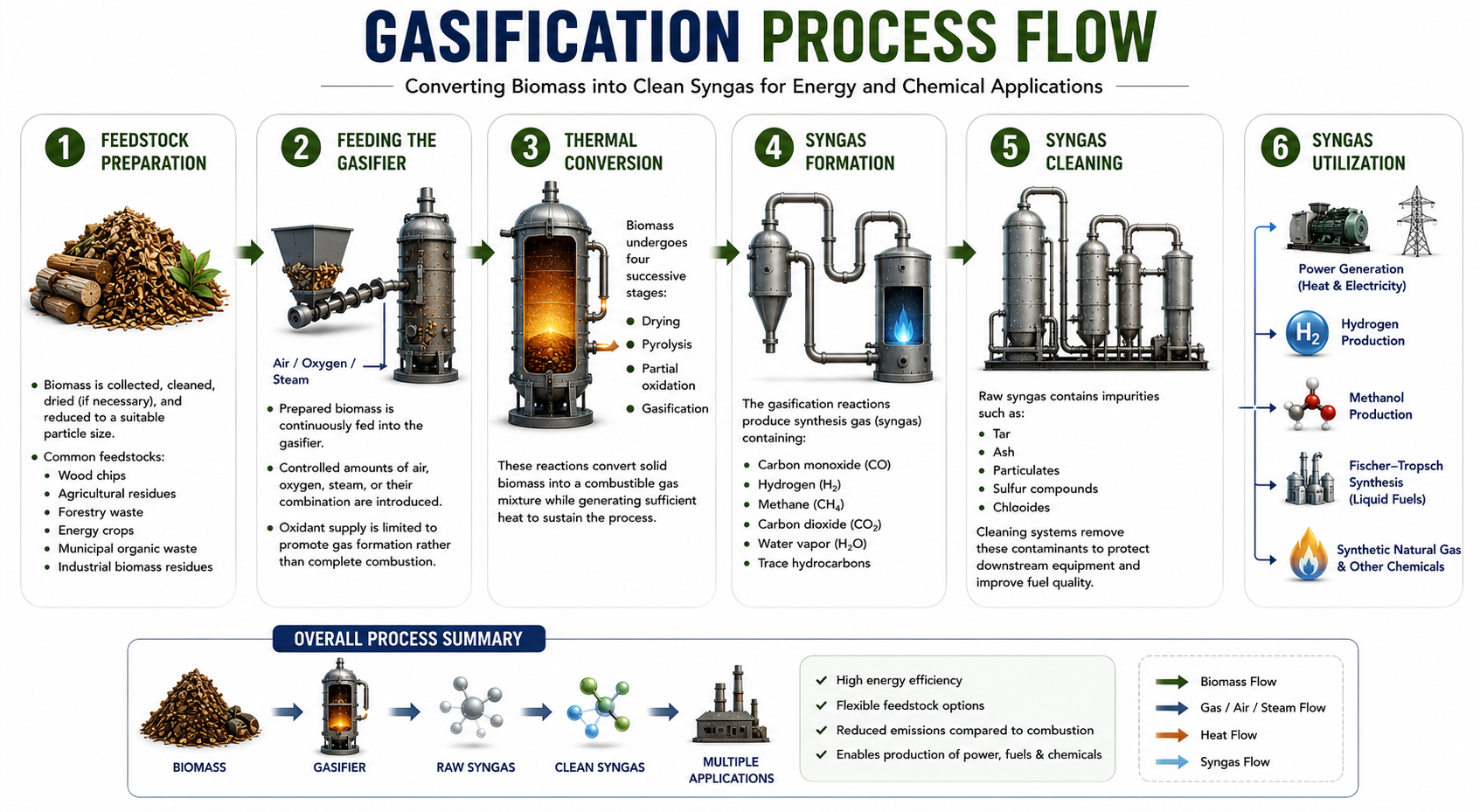
The gasification process consists of several interconnected stages.
1. Feedstock Preparation
Biomass is collected, cleaned, dried if necessary, and reduced to a suitable particle size.
Common feedstocks include:
- Wood chips
- Agricultural residues
- Forestry waste
- Energy crops
- Municipal organic waste
- Industrial biomass residues
2. Feeding the Gasifier
Prepared biomass is continuously fed into the gasifier, where controlled amounts of air, oxygen, steam, or combinations of these are introduced.
Unlike combustion, the oxidant supply is carefully limited to promote gas formation rather than complete burning.
3. Thermal Conversion
Inside the gasifier, biomass undergoes four successive stages:
- Drying
- Pyrolysis
- Partial oxidation
- Gasification
These reactions convert solid biomass into a combustible gas mixture while generating sufficient heat to sustain the process.
4. Syngas Formation
The gasification reactions produce a mixture containing:
- Carbon monoxide (CO)
- Hydrogen (H₂)
- Methane (CH₄)
- Carbon dioxide (CO₂)
- Water vapor
- Trace hydrocarbons
This mixture is known as synthesis gas (syngas).
5. Syngas Cleaning
Raw syngas contains impurities such as:
- Tar
- Ash
- Particulates
- Sulfur compounds
- Chlorides
Cleaning systems remove these contaminants to protect downstream equipment and improve fuel quality.
6. Syngas Utilization
After cleaning, syngas can be:
- Burned directly for heat and electricity
- Converted into hydrogen
- Used for methanol production
- Processed through Fischer–Tropsch synthesis
- Converted into synthetic natural gas or other chemicals
Feedstock Options
- Forestry Residues – Wood chips, sawdust, bark, logging residues
- Agricultural Residues – Rice husk, wheat straw, corn stover, sugarcane bagasse
- Energy Crops – Switchgrass, miscanthus, willow, poplar
- Municipal Solid Waste (MSW) – Organic and combustible waste fractions
- Industrial Biomass Residues – Paper sludge, pulp waste, sawmill residues
- Animal Waste – Poultry litter and livestock manure (in suitable gasification systems)
- Sewage Sludge – Dried municipal and industrial sludge
Key Operating Parameters
|
Parameter |
Typical Range |
Influence on Process |
|
Temperature |
700–1,200°C |
Higher temperatures improve carbon conversion and reduce tar formation. |
|
Pressure |
Atmospheric to 30 bar |
Elevated pressure benefits downstream fuel synthesis and improves process integration. |
|
Equivalence Ratio |
0.2–0.4 |
Controls the amount of oxygen supplied and strongly influences syngas composition. |
|
Steam-to-Biomass Ratio |
Process dependent |
Higher steam input increases hydrogen production through steam-reforming reactions. |
|
Particle Size |
Typically 5–50 mm |
Uniform particle size improves heat transfer and reactor performance. |
|
Moisture Content |
Ideally <20 wt.% |
Excess moisture reduces gasification efficiency and lowers syngas heating value. |
Why Gasification Matters
Gasification is one of the most versatile biomass conversion technologies, transforming solid biomass into syngas—a flexible intermediate that can be converted into clean fuels, hydrogen, electricity, and high-value chemicals. Its ability to serve as a bridge between biomass and advanced fuel synthesis makes it a cornerstone of the emerging low-carbon bioeconomy.
- Converts biomass into syngas, a versatile building block for fuels, chemicals, and power generation.
- Enables the production of green hydrogen, methanol, and synthetic fuels, expanding the value of renewable biomass.
- Utilizes a wide variety of biomass and waste feedstocks, reducing reliance on fossil resources.
- Integrates seamlessly with downstream technologies such as Fischer–Tropsch synthesis and methanation.
- Supports industrial decarbonization by providing renewable alternatives for energy-intensive sectors.
- Maximizes biomass utilization, enabling the production of multiple high-value products from a single conversion platform.
Commercial Opportunity
Growing demand for low-carbon fuels and renewable chemicals is driving renewed investment in biomass gasification technologies worldwide.
- Rising demand for green hydrogen is creating new markets for biomass-derived syngas.
- Expansion of Sustainable Aviation Fuel (SAF) and renewable fuel production is increasing the need for gasification-based feedstocks.
- Waste-to-energy initiatives are promoting the use of municipal and agricultural residues for syngas production.
- Industrial sectors seeking to reduce carbon emissions are exploring renewable syngas as an alternative to fossil fuels.
- Integration with existing chemical and refining infrastructure enables the production of renewable fuels and chemicals at commercial scale.
- Government support for advanced biofuels, hydrogen, and circular economy initiatives continues to accelerate project development.
Key Challenges in Commercializing Gasification
- Feedstock Availability and Quality
Variations in biomass type, moisture content, ash content, and particle size can significantly affect gasifier performance and syngas quality. - Tar Formation
Gasification produces tar and other condensable compounds that can foul equipment and must be removed before syngas utilization. - Syngas Cleaning and Purification
Raw syngas contains particulates, sulfur compounds, chlorides, and other impurities that require extensive cleaning for downstream applications. - High Capital Investment
Commercial gasification plants require significant investment in gasifiers, gas cleaning systems, heat recovery units, and downstream fuel synthesis infrastructure. - Process Efficiency and Heat Integration
Maximizing energy efficiency through effective heat recovery and process integration is essential for improving overall plant economics. - Economic Competitiveness
Gasification-derived fuels and chemicals must compete with conventional fossil-based alternatives, requiring cost reductions and supportive market incentives. - Policy and Infrastructure Support
Large-scale deployment depends on stable renewable energy policies, sustainable biomass supply chains, and infrastructure for hydrogen, synthetic fuels, and syngas utilization.
Major Products Produced Through Gasification
|
End Product |
Typical Feedstock |
Primary Market |
|
Synthesis Gas (Syngas) |
Forestry and agricultural residues, MSW |
Energy, chemicals, industrial processes |
|
Green Hydrogen |
Biomass-derived syngas |
Fuel cells, refining, ammonia, steel |
|
Methanol |
Biomass-derived syngas |
Chemicals, fuels, plastics |
|
Fischer–Tropsch Fuels |
Biomass-derived syngas |
Transportation fuels, aviation |
|
Electricity & Heat |
Syngas |
Power generation, industrial heating |
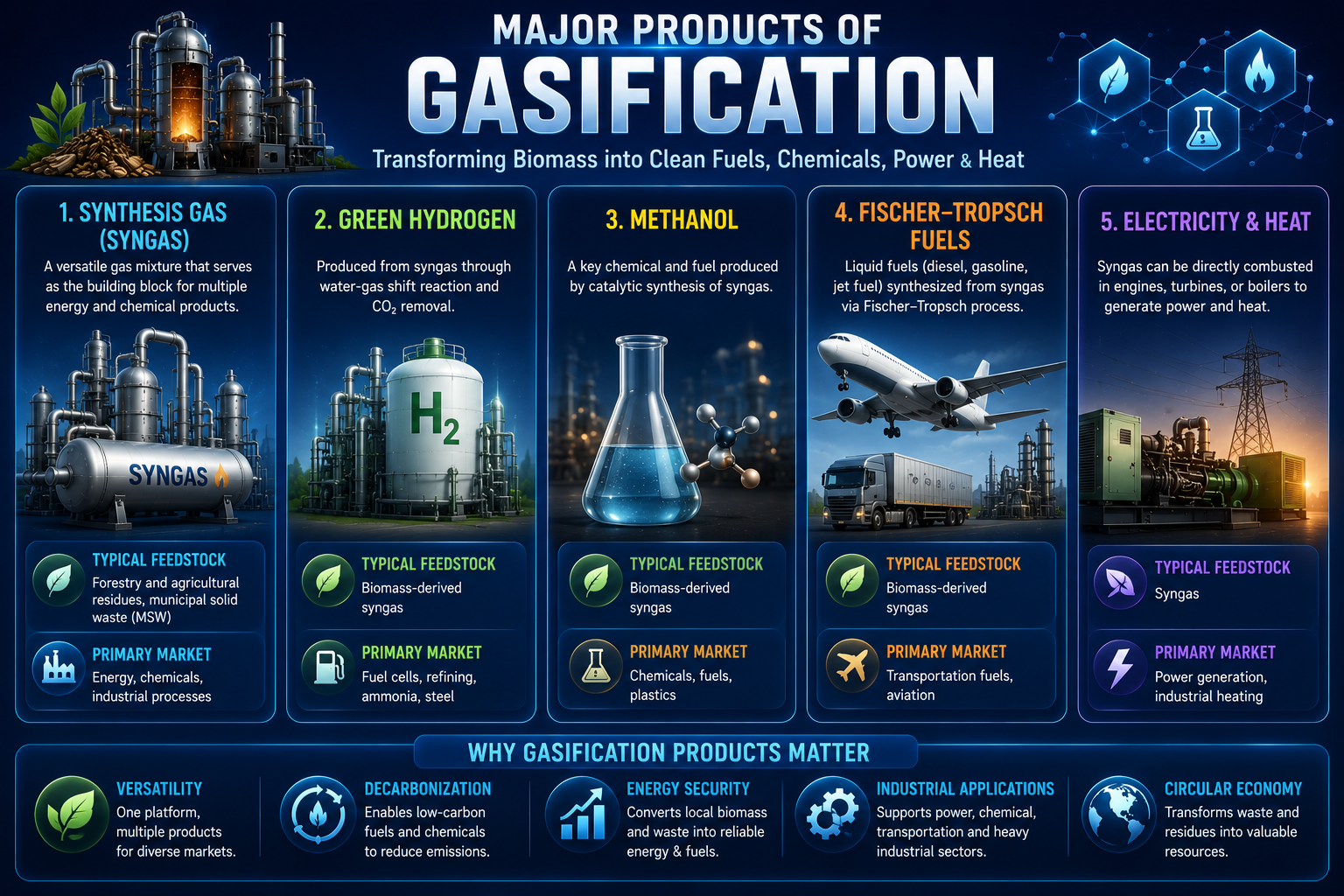
1. Synthesis Gas (Syngas)
Feedstock: Forestry residues, agricultural residues, municipal solid waste
Process: Biomass → Gasification → Syngas
Syngas is the primary product of gasification, consisting mainly of carbon monoxide (CO) and hydrogen (H₂). It serves as a versatile intermediate for producing fuels, electricity, and chemicals.
Key Applications: Power generation, industrial heating, chemical synthesis
2. Green Hydrogen
Feedstock: Biomass-derived syngas
Process: Syngas → Water-Gas Shift Reaction → Hydrogen Separation
Hydrogen can be recovered from syngas through catalytic conversion and purification, providing a renewable alternative for clean energy applications.
Key Applications: Fuel cells, refineries, ammonia production, steel manufacturing
3. Methanol
Feedstock: Biomass-derived syngas
Process: Syngas → Catalytic Synthesis → Methanol
Methanol is one of the most important chemicals produced from syngas and serves as a platform chemical for numerous industrial applications.
Key Applications: Chemicals, fuels, plastics, formaldehyde production
4. Fischer–Tropsch Fuels
Feedstock: Biomass-derived syngas
Process: Syngas → Fischer–Tropsch Synthesis → Liquid Hydrocarbons
Gasification-derived syngas can be converted into high-quality synthetic fuels, including renewable diesel, Sustainable Aviation Fuel (SAF), and renewable gasoline.
Key Applications: Road transport, aviation, heavy-duty transport
5. Electricity and Heat
Feedstock: Syngas
Process: Syngas → Gas Engine/Turbine → Electricity & Heat
Syngas can be combusted in gas engines or turbines to generate electricity and useful heat with high efficiency.
Key Applications: Combined heat and power (CHP), industrial energy, distributed power generation
Future Growth Drivers
The future of gasification will be driven by its ability to supply renewable carbon and hydrogen for next-generation fuels, chemicals, and industrial processes.
- Growing demand for green hydrogen and synthetic fuels will significantly increase the value of biomass-derived syngas.
- Expansion of biomass-to-liquids (BtL) and waste-to-fuels projects will drive commercial deployment of advanced gasification systems.
- Advances in gasifier design, syngas cleaning, and process integration will improve efficiency and reduce operating costs.
- Greater integration with Fischer–Tropsch synthesis, methanation, and methanol production will expand product diversity and plant profitability.
- Increasing emphasis on carbon capture and utilization (CCU) will enhance the environmental performance of gasification-based systems.
- Net-zero targets, renewable energy policies, and industrial decarbonization strategies will continue to strengthen investment and commercial adoption of gasification technologies.