
Hydrolytic and catalytic upgrading are complementary technologies used to convert biomass-derived intermediates into higher-value fuels and chemicals. Hydrolytic upgrading uses water, enzymes, or acids to break down complex biomass polymers into fermentable sugars or other simple molecules, while catalytic upgrading employs catalysts to remove oxygen, improve stability, and convert bio-oils or biocrudes into transportation fuels and chemical feedstocks. Together, these technologies bridge the gap between raw biomass conversion and the production of commercially usable bio-based products. The following will be covered in the upcoming sections.
- The Science Behind Hydrolytic and catalytic upgrading
- Hydrolytic and catalytic upgrading Process
- Feedstock Utilization
- Factors Affecting Product Yield
- Why Hydrolytic and catalytic upgrading are an Essential Biorefinery Technology
- Why Hydrolytic and catalytic upgrading matters
- Commercial Opportunity
- Key Challenges in Commercializing Hydrolytic and catalytic upgrading
- Major Products Produced Through Hydrolytic and catalytic upgrading
- Future Growth Drivers
The Science Behind Hydrolytic and Catalytic Upgrading
Hydrolytic and catalytic upgrading are biomass refining technologies that convert biomass-derived intermediates into higher-value fuels, chemicals, and platform molecules. Rather than converting raw biomass directly, these processes upgrade products obtained from technologies such as pyrolysis, hydrothermal liquefaction (HTL), gasification, and biochemical conversion, improving their quality, stability, and commercial value.
Hydrolytic upgrading breaks down complex biomass polymers into simpler molecules using water, enzymes, or acids, making them suitable for fermentation or chemical conversion. Catalytic upgrading then uses solid catalysts and controlled reaction conditions to remove oxygen, rearrange molecular structures, and convert biomass-derived oils or sugars into high-quality fuels and specialty chemicals
The Science Behind Hydrolytic Upgrading
Biomass is primarily composed of:
- Cellulose
- Hemicellulose
- Lignin
Hydrolysis targets the carbohydrate fraction of biomass by breaking the chemical bonds that hold these polymers together.
Cellulose Hydrolysis
Cellulose consists of long chains of glucose molecules linked by β-1,4-glycosidic bonds. During hydrolysis, these bonds are broken to produce glucose, which can be fermented into biofuels or converted into bio-based chemicals.
Hemicellulose Hydrolysis
Hemicellulose is converted into a mixture of five- and six-carbon sugars such as xylose, arabinose, and mannose, expanding the range of fermentable feedstocks.
Lignin Separation
Lignin is largely resistant to hydrolysis and is separated from the carbohydrate fraction. It can later be utilized for energy production or upgraded into aromatic chemicals.
Get in touch
Interested in biochar, bioplastics, biopolymers, or other bio-based business opportunities in India? Get expert guidance from our team
Call Muthu
The Science Behind Catalytic Upgrading
Many biomass-derived products such as pyrolysis bio-oil and HTL biocrude contain high levels of oxygen, making them acidic, unstable, and unsuitable for direct fuel applications.
Catalytic upgrading removes oxygen and improves fuel quality through reactions such as:
- Hydrodeoxygenation (HDO)
- Hydrogenation
- Catalytic cracking
- Isomerization
These reactions increase energy density, improve stability, and produce hydrocarbons similar to conventional petroleum fuels.
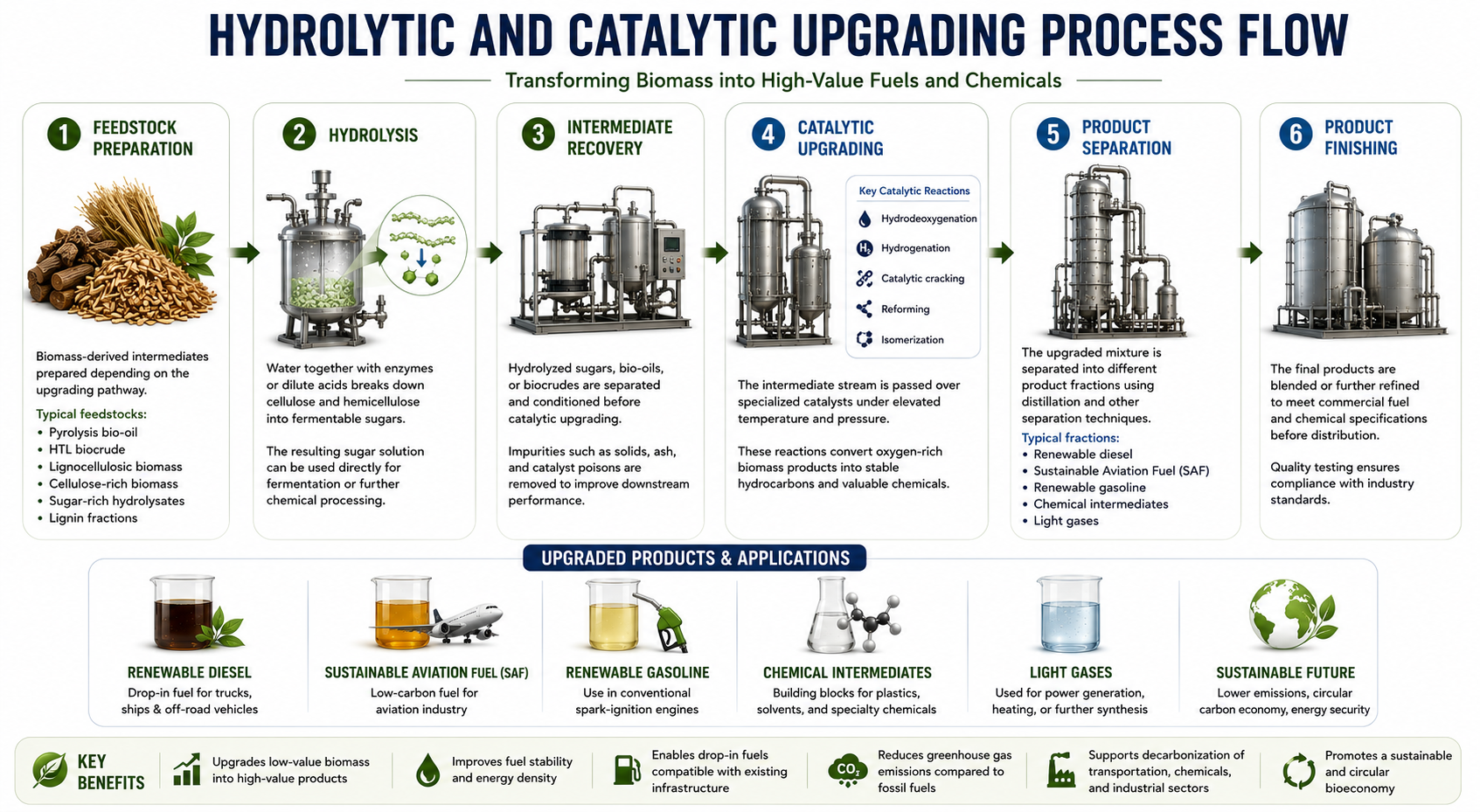
How Hydrolytic and Catalytic Upgrading Works
The upgrading process consists of several interconnected stages.
1. Feedstock Preparation
Biomass-derived intermediates are prepared depending on the upgrading pathway.
Typical feedstocks include:
- Pyrolysis bio-oil
- HTL biocrude
- Lignocellulosic biomass
- Cellulose-rich biomass
- Sugar-rich hydrolysates
- Lignin fractions
2. Hydrolysis
For lignocellulosic biomass, water together with enzymes or dilute acids breaks down cellulose and hemicellulose into fermentable sugars.
The resulting sugar solution can be used directly for fermentation or further chemical processing.
3. Intermediate Recovery
The hydrolyzed sugars, bio-oils, or biocrudes are separated and conditioned before catalytic upgrading.
Impurities such as solids, ash, and catalyst poisons are removed to improve downstream performance.
4. Catalytic Upgrading
The intermediate stream is passed over specialized catalysts under elevated temperature and pressure.
Depending on the desired product, catalytic reactions include:
- Hydrodeoxygenation
- Hydrogenation
- Catalytic cracking
- Reforming
- Isomerization
These reactions convert oxygen-rich biomass products into stable hydrocarbons and valuable chemicals.
5. Product Separation
The upgraded mixture is separated into different product fractions using distillation and other separation techniques.
Typical fractions include:
- Renewable diesel
- Sustainable Aviation Fuel (SAF)
- Renewable gasoline
- Chemical intermediates
- Light gases
6. Product Finishing
The final products are blended or further refined to meet commercial fuel and chemical specifications before distribution.
Feedstock Options
- Lignocellulosic Biomass – Agricultural residues, forestry residues, energy crops
- Pyrolysis Bio-oil – Bio-oil produced from fast pyrolysis
- HTL Biocrude – Biocrude obtained from hydrothermal liquefaction
- Sugar-Rich Hydrolysates – Cellulose- and hemicellulose-derived sugar streams
- Lignin-Rich Fractions – Residual lignin from biorefineries and pulp mills
- Algal Biomass – Microalgae and macroalgae-derived oils and carbohydrates
- Industrial Biomass Residues – Pulp and paper residues, food processing by-products, distillery waste
Key Operating Parameters
|
Parameter |
Typical Range |
Influence on Process |
|
Hydrolysis Temperature |
45–200°C |
Depends on enzymatic or acid hydrolysis; affects sugar release and conversion efficiency. |
|
Catalytic Upgrading Temperature |
250–450°C |
Higher temperatures promote deoxygenation and hydrocarbon formation. |
|
Pressure |
1–20 MPa |
Elevated pressures improve catalytic hydrogenation and upgrading efficiency. |
|
Catalyst Type |
Metal or solid acid catalysts |
Determines reaction selectivity, fuel quality, and product distribution. |
|
Hydrogen Availability |
Process dependent |
Essential for hydrodeoxygenation and improving fuel stability. |
|
Residence Time |
Minutes to hours |
Influences conversion, product yield, and catalyst performance. |
Why Hydrolytic and Catalytic Upgrading Matters
Hydrolytic and catalytic upgrading transform biomass-derived intermediates into high-value fuels and chemicals, making them essential technologies for modern biorefineries. By improving product quality, increasing conversion efficiency, and maximizing biomass utilization, these upgrading processes bridge the gap between raw biomass conversion and commercially viable bio-based products.
- Converts low-value biomass intermediates into premium fuels and chemicals, significantly increasing their commercial value.
- Improves the quality and stability of bio-oils and biocrudes, making them compatible with existing fuel and refinery infrastructure.
- Unlocks fermentable sugars from lignocellulosic biomass, expanding the use of agricultural and forestry residues.
- Maximizes biomass utilization by converting multiple biomass fractions into valuable products.
- Supports integrated biorefineries, linking thermochemical and biochemical conversion pathways.
- Reduces dependence on petroleum refining by producing renewable fuels and chemical building blocks from biomass.
Commercial Opportunity
Growing demand for advanced biofuels and renewable chemicals is driving investment in upgrading technologies that improve the value of biomass-derived products.
- Increasing production of pyrolysis bio-oils and HTL biocrudes is creating demand for efficient upgrading technologies.
- Growing markets for renewable diesel, Sustainable Aviation Fuel (SAF), and bio-based chemicals are expanding commercial opportunities.
- Expansion of integrated biorefineries is increasing the need for technologies that maximize product yield and resource efficiency.
- Existing petroleum refineries offer opportunities to co-process upgraded biomass intermediates using established infrastructure.
- Rising demand for renewable chemical feedstocks is encouraging investment in catalytic conversion technologies.
- Government incentives for advanced biofuels and low-carbon manufacturing continue to support commercialization.
Key Challenges in Commercializing Hydrolytic and Catalytic Upgrading
- Feedstock Variability
Differences in biomass composition and intermediate quality can affect conversion efficiency, catalyst performance, and final product yields. - Catalyst Performance and Lifetime
Catalysts gradually lose activity due to fouling, coking, and impurities, increasing replacement costs and reducing process efficiency. - Hydrogen Demand
Catalytic upgrading processes such as hydrodeoxygenation require significant amounts of hydrogen, increasing operating costs and energy consumption. - Process Integration
Efficiently integrating hydrolysis, upgrading, and downstream separation with existing biorefineries remains a major engineering challenge. - High Capital and Operating Costs
Advanced reactors, high-pressure equipment, catalyst systems, and product purification units require substantial investment. - Product Quality and Selectivity
Maintaining consistent fuel quality and maximizing desired products while minimizing unwanted by-products requires precise process control. - Economic Competitiveness
Commercial success depends on reducing production costs, improving catalyst efficiency, and competing with established petroleum-based refining technologies.
Major Products Produced Through Hydrolytic and Catalytic Upgrading
|
End Product |
Typical Feedstock |
Primary Market |
|
Renewable Diesel |
HTL biocrude, pyrolysis bio-oil, vegetable oils |
Transportation fuels |
|
Sustainable Aviation Fuel (SAF) |
HTL biocrude, pyrolysis bio-oil, algal oils |
Aviation |
|
Renewable Gasoline & Naphtha |
Bio-oil, biomass-derived hydrocarbons |
Transportation, petrochemicals |
|
Platform Chemicals |
Sugar hydrolysates, lignin fractions |
Chemicals, pharmaceuticals, bioplastics |
|
Aromatics & Specialty Chemicals |
Lignin-rich fractions, upgraded bio-oils |
Plastics, coatings, specialty chemicals |
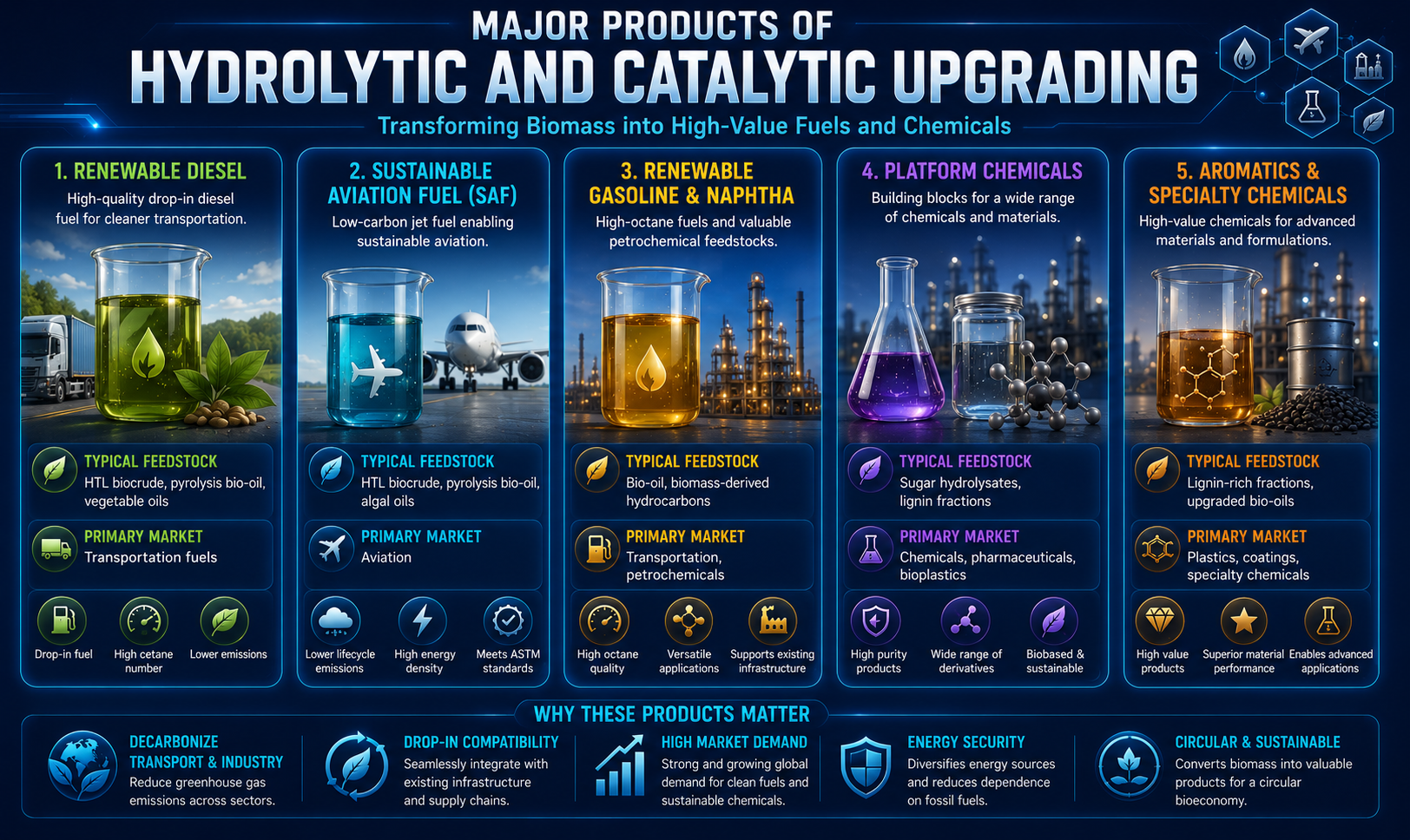
1. Renewable Diesel
Feedstock: HTL biocrude, pyrolysis bio-oil, vegetable oils
Process: Biomass Intermediates → Catalytic Upgrading → Renewable Diesel
Catalytic upgrading removes oxygen and improves fuel properties to produce high-quality renewable diesel that is fully compatible with existing diesel engines.
Key Applications: Road transport, heavy vehicles, industrial machinery
2. Sustainable Aviation Fuel (SAF)
Feedstock: HTL biocrude, pyrolysis bio-oil, algal oils
Process: Biomass Intermediates → Hydroprocessing → Sustainable Aviation Fuel
Upgraded biomass-derived oils can be converted into drop-in aviation fuels that meet stringent aviation fuel standards.
Key Applications: Commercial aviation, cargo aircraft, military aviation
3. Renewable Gasoline & Naphtha
Feedstock: Bio-oil, biocrude, biomass-derived hydrocarbons
Process: Catalytic Upgrading → Distillation → Gasoline & Naphtha
Lighter hydrocarbon fractions are refined into renewable gasoline and naphtha for use as transportation fuels and petrochemical feedstocks.
Key Applications: Passenger vehicles, petrochemical industry
4. Platform Chemicals
Feedstock: Sugar hydrolysates, lignin fractions, bio-oils
Process: Hydrolysis/Catalytic Conversion → Platform Chemicals
Hydrolytic and catalytic upgrading produce valuable platform molecules that serve as building blocks for numerous bio-based products.
Examples of Products:
- Furfural
- 5-Hydroxymethylfurfural (HMF)
- Levulinic acid
- Xylitol
Key Applications: Chemicals, solvents, resins, pharmaceuticals, bioplastics
5. Aromatics and Specialty Chemicals
Feedstock: Lignin-rich fractions, upgraded bio-oils
Process: Catalytic Upgrading → Aromatic Compounds
Lignin and oxygenated bio-oils can be upgraded into renewable aromatic compounds and specialty chemicals traditionally derived from petroleum.
Key Applications: Plastics, coatings, adhesives, specialty chemicals
Future Growth Drivers
The future of hydrolytic and catalytic upgrading will be driven by the increasing need to produce higher-value fuels and chemicals from renewable biomass while improving the efficiency of integrated biorefineries.
- Growing production of biomass-derived intermediates such as bio-oils, biocrudes, and lignocellulosic hydrolysates will increase demand for upgrading technologies.
- Expansion of renewable diesel, Sustainable Aviation Fuel (SAF), and bio-based chemical markets will strengthen the commercial value of catalytic upgrading.
- Advances in catalyst design, enzyme engineering, and process integration will improve conversion efficiency and reduce production costs.
- Greater integration with existing refinery infrastructure will accelerate the commercialization of biomass-derived fuels.
- Increasing emphasis on complete biomass valorization will encourage the conversion of all biomass fractions into valuable products.
- Global decarbonization goals and the transition toward a circular bioeconomy will continue to drive investment in advanced biomass upgrading technologies.