
Combustion is the direct thermochemical conversion of biomass into heat by reacting it with an excess supply of oxygen. During the process, the carbon and hydrogen present in biomass are oxidized to produce heat, carbon dioxide (CO₂), and water vapor (H₂O). The generated heat can be used directly for industrial heating or converted into electricity through steam turbines, making combustion the most widely deployed biomass-to-energy technology worldwide. The following will be covered in the coming sections
- The Chemistry Behind Combustion
- Combustion Process
- Feedstock Utilization
- Factors Affecting Product Yield
- Why Combustion is the most Mature Biomass Conversion Technology
- Why Combustion Matters
- Commercial Opportunity
- Key Challenges in Commercializing Combustion
- Major Products Produced Through Combustion
- Future Growth Drivers
The Chemistry Behind Combustion
The combustion of biomass involves the oxidation of carbon and hydrogen in the presence of oxygen.
The principal reactions are:
Carbon Oxidation
C + O₂ → CO₂ + Heat
Hydrogen Oxidation
2H₂ + O₂ → 2H₂O + Heat
Overall Biomass Combustion (Simplified)
Biomass + O₂ → CO₂ + H₂O + Heat + Ash
Get in touch
Interested in biochar, bioplastics, biopolymers, or other bio-based business opportunities in India? Get expert guidance from our team
Call Muthu
These reactions are highly exothermic, releasing large amounts of thermal energy that can be recovered for heating or electricity generation.
How Combustion Works
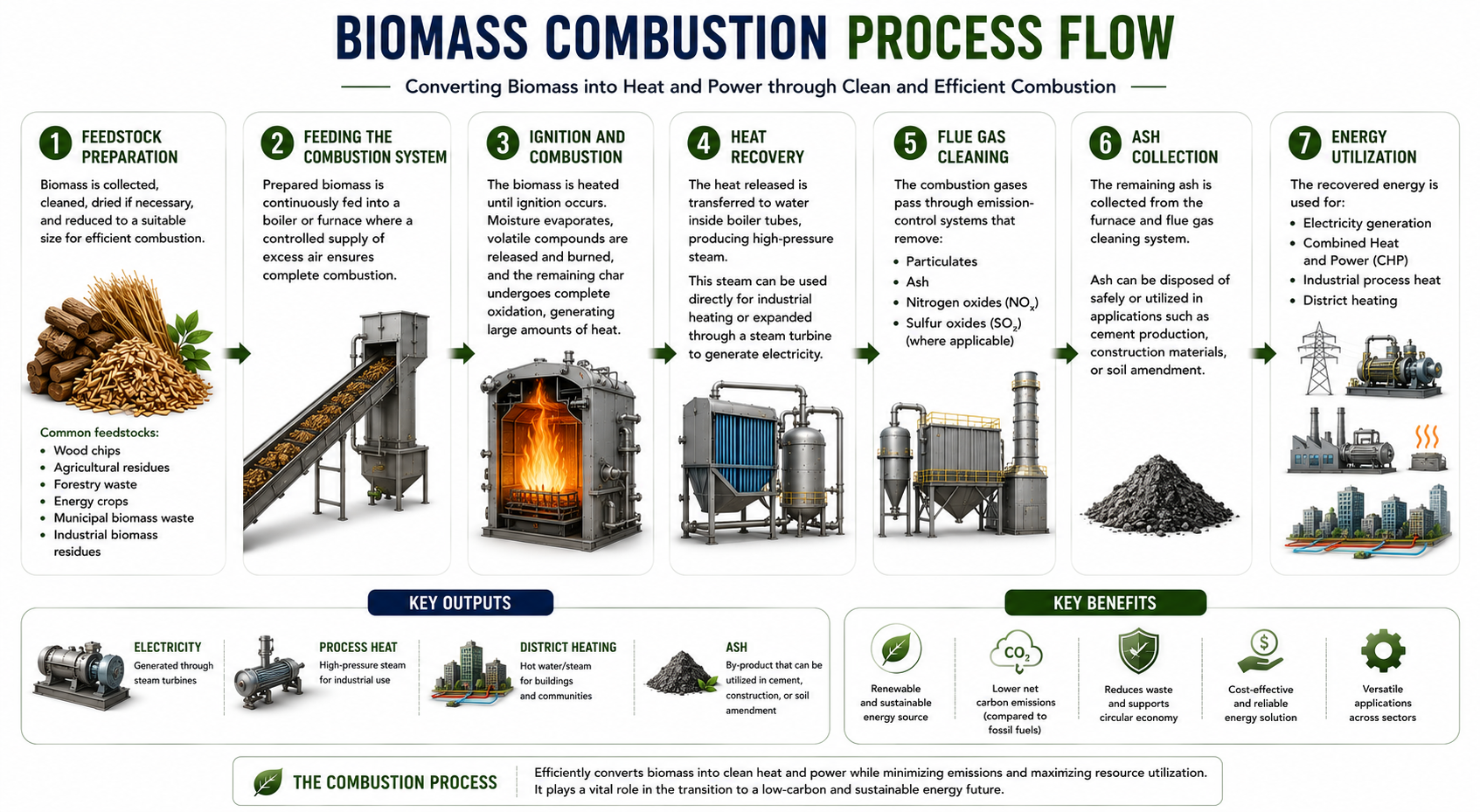
The combustion process consists of several interconnected stages.
1. Feedstock Preparation
Biomass is collected, cleaned, dried if necessary, and reduced to a suitable size for efficient combustion.
Common feedstocks include:
- Wood chips
- Agricultural residues
- Forestry waste
- Energy crops
- Municipal biomass waste
- Industrial biomass residues
2. Feeding the Combustion System
Prepared biomass is continuously fed into a boiler or furnace where a controlled supply of excess air ensures complete combustion.
3. Ignition and Combustion
The biomass is heated until ignition occurs.
As temperature increases, moisture evaporates, volatile compounds are released and burned, and the remaining char undergoes complete oxidation, generating large amounts of heat.
4. Heat Recovery
The heat released is transferred to water inside boiler tubes, producing high-pressure steam.
This steam can be used directly for industrial heating or expanded through a steam turbine to generate electricity.
5. Flue Gas Cleaning
The combustion gases pass through emission-control systems that remove:
- Particulates
- Ash
- Nitrogen oxides (NOₓ)
- Sulfur oxides (SOₓ) (where applicable)
This helps meet environmental emission standards.
6. Ash Collection
The remaining ash is collected from the furnace and flue gas cleaning system.
Depending on its composition, ash can be disposed of safely or utilized in applications such as cement production, construction materials, or soil amendment.
7. Energy Utilization
The recovered energy is used for:
- Electricity generation
- Combined Heat and Power (CHP)
- Industrial process heat
- District heating
Feedstock Options
- Forestry Residues – Wood chips, sawdust, bark, logging residues
- Agricultural Residues – Rice husk, wheat straw, corn stover, sugarcane bagasse
- Energy Crops – Switchgrass, miscanthus, willow, poplar
- Municipal Biomass Waste – Organic fraction of municipal solid waste (OFMSW)
- Industrial Biomass Residues – Paper sludge, pulp waste, sawmill residues
- Animal Waste – Poultry litter and livestock manure (suitable combustion systems)
- Wood Pellets and Briquettes – Densified biomass fuels for residential and industrial applications
These are the most widely used commercial feedstocks for biomass combustion, providing a reliable source of renewable heat and power.
Key Operating Parameters
|
Parameter |
Typical Range |
Influence on Process |
|
Temperature |
800–1,200°C |
Higher temperatures improve combustion efficiency and fuel burnout. |
|
Excess Air Ratio |
1.2–2.0 |
Ensures complete combustion while minimizing energy losses. |
|
Moisture Content |
<20 wt.% (preferred) |
Lower moisture improves combustion efficiency and increases heat output. |
|
Particle Size |
Feedstock dependent |
Uniform particle size promotes stable combustion and efficient heat transfer. |
|
Residence Time |
Seconds to minutes |
Sufficient residence time ensures complete fuel oxidation and lower emissions. |
Why Combustion Matters
Combustion remains the most mature and widely deployed biomass conversion technology, providing a reliable and scalable solution for renewable heat and power generation. Its simplicity, proven performance, and compatibility with existing energy infrastructure make it a cornerstone of the global bioenergy industry.
- Converts biomass directly into renewable heat and electricity with proven, commercial-scale technologies.
- Utilizes a wide range of biomass residues and waste streams, reducing landfill disposal and open-field burning.
- Supports the replacement of fossil fuels in power generation, industrial heating, and district heating systems.
- Integrates with Combined Heat and Power (CHP) systems, maximizing overall energy efficiency.
- Leverages existing boiler and steam turbine infrastructure, enabling rapid deployment with lower technical risk.
- Provides dependable baseload renewable energy, complementing intermittent sources such as solar and wind.
Commercial Opportunity
The growing demand for renewable heat, reliable power generation, and sustainable waste management continues to drive the commercial deployment of biomass combustion systems.
- Increasing demand for renewable industrial heat is encouraging industries to replace coal and fuel oil with biomass.
- Expansion of biomass-fired power plants and CHP facilities is improving energy efficiency while reducing emissions.
- Growing utilization of agricultural and forestry residues is creating value from previously underutilized biomass resources.
- Industrial sectors such as cement, pulp and paper, and food processing are adopting biomass combustion to meet decarbonization targets.
- Municipal waste-to-energy projects are expanding opportunities for biomass-based energy recovery.
- Renewable energy incentives and carbon reduction policies continue to strengthen investment in biomass combustion technologies.
Key Challenges in Commercializing Combustion
- Feedstock Quality and Moisture Content
High moisture content and inconsistent biomass quality reduce combustion efficiency and increase fuel consumption. - Emission Control
Biomass combustion generates particulate matter, nitrogen oxides (NOₓ), and other emissions that require advanced pollution control systems. - Ash Management
Ash produced during combustion must be properly handled, disposed of, or valorized, particularly when feedstocks contain high mineral content. - Boiler Fouling and Corrosion
Alkali metals, chlorine, and ash-forming compounds can cause slagging, fouling, and corrosion, reducing equipment performance and lifespan. - Feedstock Supply and Logistics
Seasonal biomass availability and transportation costs can affect the reliability and economics of commercial combustion facilities. - Economic Competitiveness
Biomass combustion must compete with conventional fossil fuels, requiring efficient plant operation and supportive renewable energy policies. - Policy and Sustainability Requirements
Long-term deployment depends on sustainable biomass sourcing, emissions regulations, and incentives that support renewable heat and power generation.
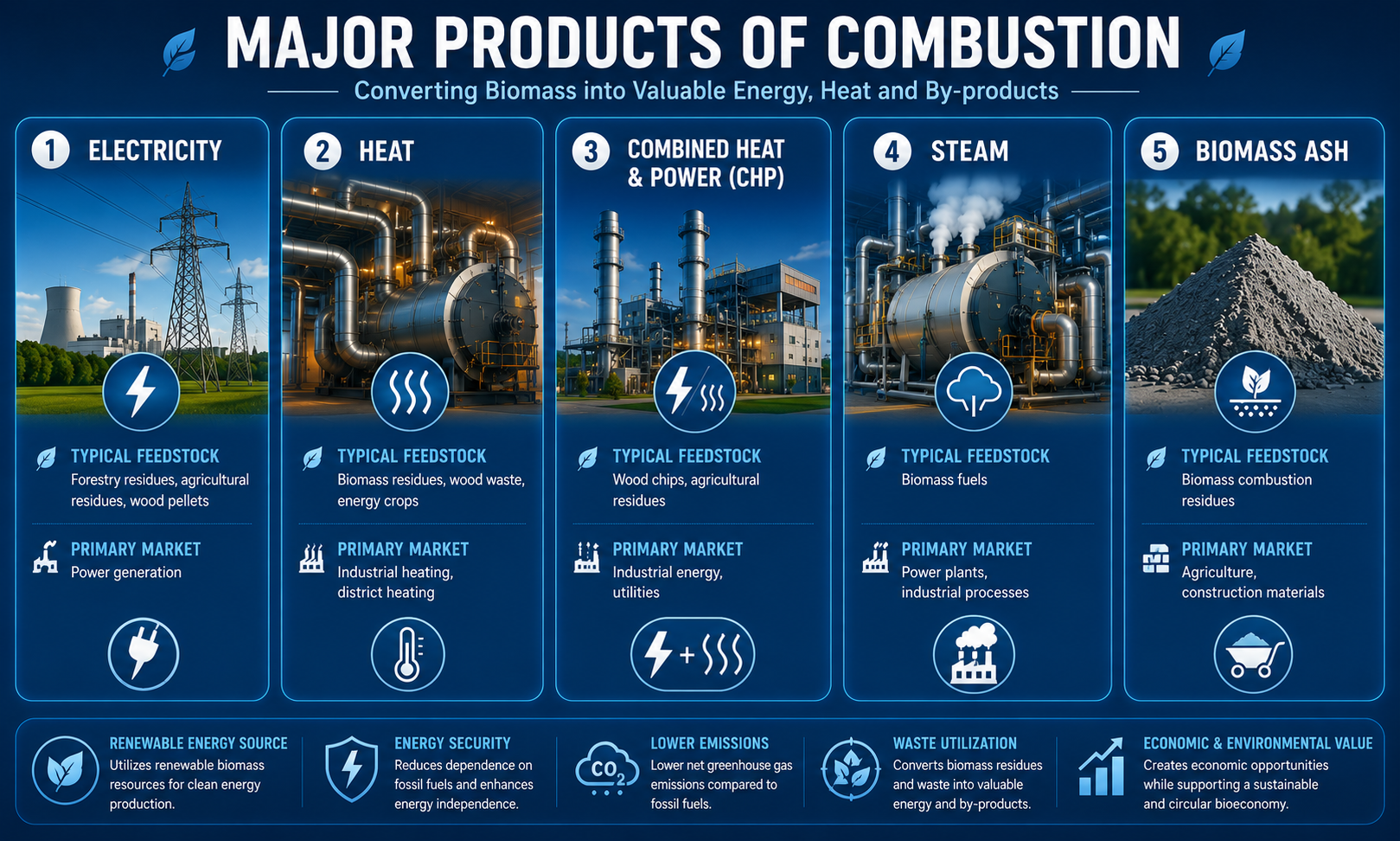
Major Products Produced Through Combustion
|
End Product |
Typical Feedstock |
Primary Market |
|
Electricity |
Forestry residues, agricultural residues, wood pellets |
Power generation |
|
Heat |
Biomass residues, wood waste, energy crops |
Industrial heating, district heating |
|
Combined Heat & Power (CHP) |
Wood chips, agricultural residues |
Industrial energy, utilities |
|
Steam |
Biomass fuels |
Power plants, industrial processes |
|
Biomass Ash |
Biomass combustion residues |
Agriculture, construction materials |
1. Electricity
Feedstock: Forestry residues, agricultural residues, wood pellets
Process: Biomass → Combustion → Steam → Turbine → Electricity
Heat generated during combustion is used to produce steam, which drives turbines to generate renewable electricity.
Key Applications: Grid electricity, industrial power, distributed energy
2. Heat
Feedstock: Biomass residues, wood waste, energy crops
Process: Biomass → Combustion → Thermal Energy
Combustion produces large amounts of thermal energy that can be used directly for industrial processes, drying, and space heating.
Key Applications: Industrial heating, district heating, process heat
3. Combined Heat and Power (CHP)
Feedstock: Wood chips, agricultural residues, biomass pellets
Process: Biomass → Combustion → Electricity + Heat
CHP systems simultaneously generate electricity and recover useful heat, significantly improving overall energy efficiency.
Key Applications: Industrial facilities, campuses, district energy systems
4. Steam
Feedstock: Biomass fuels
Process: Biomass → Combustion → Steam Generation
Steam produced in biomass boilers is widely used for electricity generation and industrial manufacturing processes.
Key Applications: Power plants, food processing, pulp and paper, chemical industries
5. Biomass Ash
Feedstock: Biomass combustion residues
Process: Combustion → Ash Collection
Ash is the primary solid by-product of biomass combustion and can often be utilized as a soil amendment or as a raw material in construction products, depending on its composition.
Key Applications: Agriculture, cement, bricks, construction materials
Future Growth Drivers
The future of biomass combustion will be driven by the increasing need for reliable renewable heat, industrial decarbonization, and efficient utilization of biomass resources.
- Growing demand for renewable process heat will continue to expand biomass combustion in energy-intensive industries.
- Coal phase-out initiatives will accelerate the replacement of fossil fuels with sustainable biomass fuels in existing power plants.
- Expansion of Combined Heat and Power (CHP) systems will improve energy efficiency and overall plant economics.
- Advances in combustion technologies, boiler efficiency, and emission control systems will reduce environmental impacts while improving performance.
- Increasing availability of biomass pellets, briquettes, and other densified fuels will strengthen biomass supply chains and facilitate large-scale deployment.
- Long-term climate policies, renewable energy targets, and sustainable biomass sourcing initiatives will continue to support the growth of biomass combustion worldwide.