
Fermentation is a biological conversion process that uses microorganisms such as bacteria, yeasts, and fungi to transform renewable biomass into valuable products including biofuels, chemicals, pharmaceuticals, enzymes, and biomaterials. Operating under mild conditions, it has become a cornerstone of the modern bioeconomy, with advances in metabolic engineering, synthetic biology, and precision fermentation enabling the sustainable production of a diverse range of low-carbon fuels and bio-based products from renewable feedstocks.The following will be covered in the coming sections.
- The Biological Basis of Fermentation
- Fermentation Process
- Feedstock Utilization
- Factors Affecting Fermentation Performance
- Why Fermentation Matters
- Why Fermentation is an Important Biomanufacturing Technology
- Key Challenges in Commercializing Fermentation
- Major Products Produced Through Fermentation
- Future outlook
The Biological Basis of Fermentation
Every fermentation process relies on three essential components:
- Microorganism (Biocatalyst): The biological system that carries out the conversion.
- Feedstock (Carbon Source): The substrate consumed by the microorganism.
- Controlled Bioreactor Environment: The engineered system that provides optimal conditions for microbial growth and product formation.
Fermentation Process
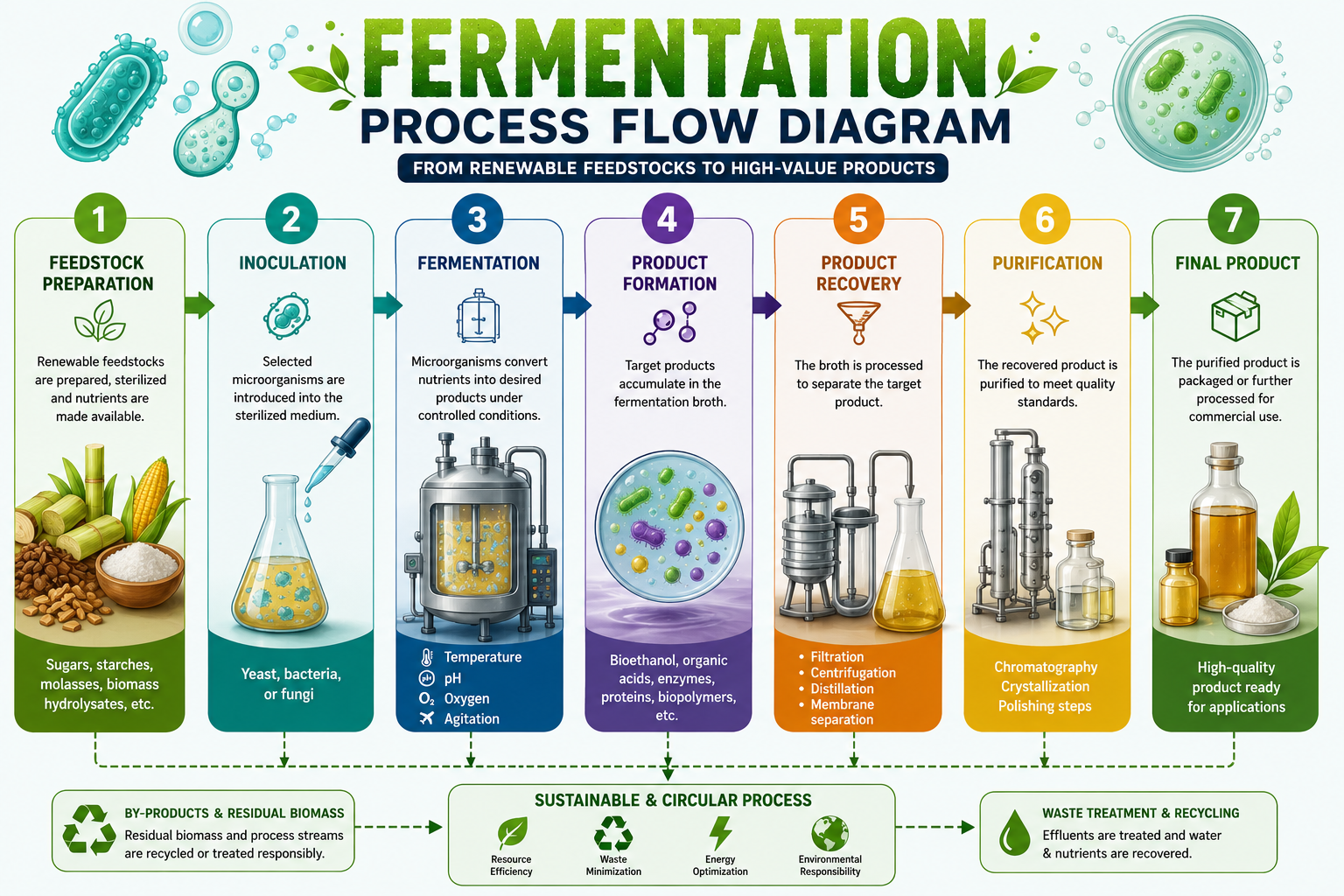
1. Feedstock Preparation
Renewable feedstocks such as sugars, starches, molasses, or biomass hydrolysates are prepared and sterilized to provide a suitable nutrient source for microorganisms.
2. Inoculation
Selected microorganisms (yeast, bacteria, or fungi) are introduced into the sterilized fermentation medium under controlled conditions.
3. Fermentation
The microorganisms consume the available nutrients and convert them into the desired products while the bioreactor maintains optimal temperature, pH, oxygen levels, and agitation.
4. Product Formation
As fermentation progresses, products such as bioethanol, organic acids, enzymes, proteins, or biopolymers accumulate in the fermentation broth.
5. Product Recovery
The fermentation broth is processed to separate the target product using techniques such as filtration, centrifugation, distillation, or membrane separation.
6. Purification
The recovered product is purified to meet the required quality standards for its intended application.
7. Final Product
The purified product is packaged or sent for further processing and commercial use, while residual biomass and process streams are recycled or treated for waste management
Get in touch
Interested in biochar, bioplastics, biopolymers, or other bio-based business opportunities in India? Get expert guidance from our team
Call Muthu
Feedstock Utilization
The first stage of fermentation involves preparing a carbon source that microorganisms can metabolize.
Depending on the process, feedstocks may include:
- Glucose
- Sucrose
- Molasses
- Corn starch
- Sugarcane juice
- Cassava
- Whey
- Food waste
- Agricultural residues
- Lignocellulosic biomass
- Glycerol
- Industrial waste streams
Factors Affecting Fermentation Performance
Parameter |
Typical Range / Condition |
Influence on Fermentation |
|
Temperature |
Organism-specific (typically 25–37°C) |
Controls microbial growth, enzyme activity, and product formation. |
|
pH |
Typically 4.5–7.5 |
Affects cell metabolism, enzyme activity, and product yield. |
|
Oxygen Availability |
Aerobic or Anaerobic |
Determines the metabolic pathway and influences the final product. |
|
Agitation & Mixing |
Moderate to high |
Ensures uniform nutrient distribution, heat transfer, and oxygen availability. |
|
Nutrient Concentration |
Carbon, nitrogen, minerals |
Adequate nutrients maximize microbial growth and productivity. |
|
Sterility |
Contamination-free conditions |
Prevents unwanted microorganisms from reducing product yield or spoiling the process. |
|
Fermentation Time |
Hours to several days |
Determines the extent of substrate conversion and final product concentration. |
Why Fermentation Matters
Fermentation has evolved beyond traditional food and beverage production into a core biomanufacturing platform capable of producing fuels, chemicals, pharmaceuticals, biomaterials, and food ingredients from renewable resources.
- Transforms renewable biomass into a wide range of high-value products, supporting multiple industries from energy to healthcare.
- Reduces dependence on fossil-based manufacturing by replacing petrochemical processes with biological production.
- Enables precision biomanufacturing through synthetic biology and metabolic engineering, allowing microorganisms to produce complex molecules with high specificity.
- Utilizes diverse renewable feedstocks, including agricultural residues, food waste, industrial by-products, and waste gases.
- Supports the circular bioeconomy by converting low-value biomass and waste streams into valuable products.
- Serves as a foundation for next-generation biotechnology, driving innovation in sustainable manufacturing and industrial biotechnology.
Commercial Opportunity
The global shift toward sustainable manufacturing and bio-based products is positioning fermentation as one of the fastest-growing technologies in the bioeconomy.
- Growing demand for bio-based chemicals, bioplastics, and alternative proteins is expanding commercial applications.
- Increasing adoption of precision fermentation is enabling the production of high-value ingredients for the food, pharmaceutical, and cosmetics industries.
- Expansion of sustainable aviation fuels and advanced biofuels is creating new opportunities for fermentation-derived intermediates.
- Advances in synthetic biology and AI-driven strain engineering are reducing production costs and accelerating product development.
- Government support for low-carbon manufacturing is encouraging investment in industrial biotechnology and biorefineries.
- Rising consumer demand for sustainable products is driving commercialization across multiple industrial sectors.
Key Challenges in Commercializing Fermentation
- Sustainable Feedstock Supply
Feedstock costs dominate production economics, while non-food biomass often requires costly pretreatment before fermentation. - High-Performance Microbial Strains
Developing robust microorganisms with high yields, faster growth, and tolerance to inhibitors remains a major research focus. - Contamination Control
Industrial fermentation requires strict sterile conditions, as microbial contamination can significantly reduce productivity or spoil entire batches. - Downstream Processing
Recovering and purifying fermentation products is often energy-intensive and can account for a significant share of total production costs. - Scale-Up Challenges
Maintaining consistent microbial performance when transitioning from laboratory to industrial-scale fermenters remains technically challenging. - Economic Competitiveness
Fermentation-derived products must compete with lower-cost petrochemical alternatives, requiring continuous process optimization and policy support. - Utilization of Next-Generation Feedstocks
Expanding the use of agricultural residues, waste streams, and industrial gases requires advanced microorganisms and more sophisticated bioprocesses.
Major Products Produced Through Fermentation
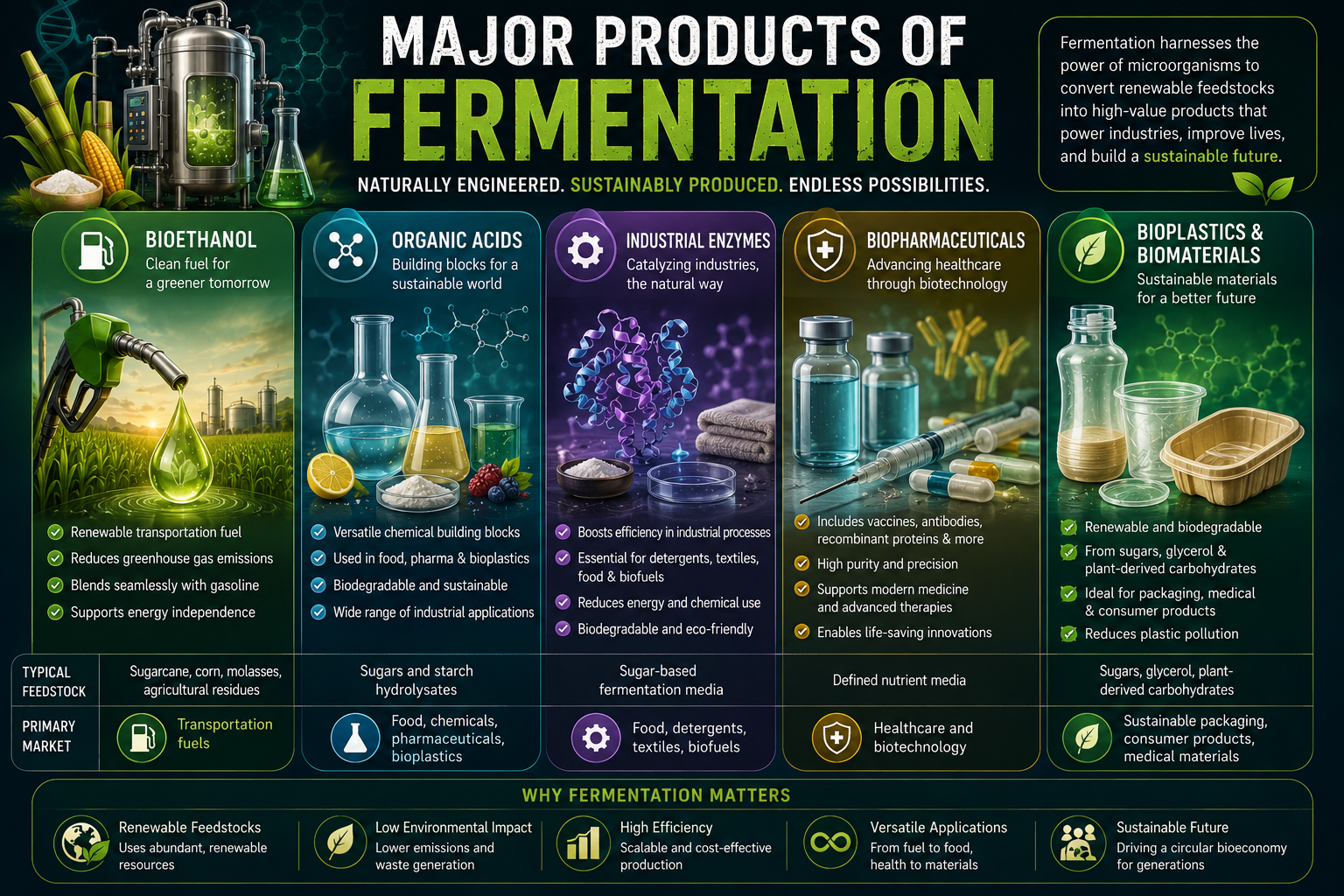
|
End Product |
Typical Feedstock |
Primary Market |
|
Bioethanol |
Sugarcane, corn, molasses, agricultural residues |
Transportation fuels |
|
Organic Acids |
Sugars and starch hydrolysates |
Food, chemicals, pharmaceuticals, bioplastics |
|
Industrial Enzymes |
Sugar-based fermentation media |
Food, detergents, textiles, biofuels |
|
Biopharmaceuticals |
Defined nutrient media |
Healthcare and biotechnology |
|
Bioplastics & Biomaterials |
Sugars, glycerol, plant-derived carbohydrates |
Sustainable packaging, consumer products, medical materials |
1. Bioethanol
Feedstock: Sugarcane, corn, wheat, molasses, agricultural residues
Process: Sugars → Yeast fermentation (Saccharomyces cerevisiae) → Ethanol → Distillation & Dehydration
Bioethanol is the world’s largest fermentation-derived biofuel and is widely blended with gasoline to reduce greenhouse gas emissions and improve fuel security. Conventional (1G) bioethanol is produced from sugar- and starch-rich crops, while second-generation (2G) bioethanol utilizes lignocellulosic biomass such as crop residues and forestry waste.
Key Applications: Transportation fuel, industrial solvent, chemical feedstock
2. Organic Acids
Feedstock: Glucose, sucrose, molasses, starch hydrolysates
Process: Sugar fermentation → Organic acid production → Purification
Fermentation is the primary industrial route for manufacturing several high-value organic acids, including lactic acid, citric acid, succinic acid, and acetic acid. These platform chemicals serve as key building blocks for food ingredients, biodegradable plastics, pharmaceuticals, and specialty chemicals.
Key Applications: Food & beverages, pharmaceuticals, biodegradable plastics (PLA), detergents, chemical manufacturing
3. Industrial Enzymes
Feedstock: Sugar-based media and nutrient-rich fermentation broths
Process: Microbial fermentation → Enzyme secretion → Recovery & Purification
Microorganisms such as bacteria and fungi are extensively used to produce industrial enzymes at commercial scale. These enzymes enable more efficient manufacturing across industries while reducing energy consumption and chemical usage.
Examples of Products:
- Amylases
- Cellulases
- Proteases
- Lipases
- Xylanases
Key Applications: Food processing, detergents, textiles, pulp & paper, biofuel production
4. Biopharmaceuticals and Therapeutic Proteins
Feedstock: Defined fermentation media
Process: Precision fermentation using engineered microorganisms → Protein expression → Purification
Modern fermentation enables microorganisms to produce complex therapeutic molecules that were previously obtainable only from animal or human sources. Recombinant DNA technology has transformed fermentation into a cornerstone of pharmaceutical manufacturing.
Examples of Products:
- Insulin
- Monoclonal antibody intermediates
- Vaccines
- Growth factors
- Therapeutic enzymes
Key Applications: Diabetes treatment, vaccines, biotechnology, healthcare
5. Bioplastics and Specialty Biomaterials
Feedstock: Sugars, plant-derived carbohydrates, glycerol
Process: Fermentation → Biopolymer or monomer production → Polymerization (where applicable)
Fermentation is increasingly being used to manufacture biodegradable plastics and renewable polymer precursors. Microorganisms can either accumulate biodegradable polymers inside their cells or produce monomers that are subsequently converted into plastics.
Examples of Products:
- Polyhydroxyalkanoates (PHA)
- Lactic acid (for PLA production)
- Bio-based succinic acid
- 1,3-Propanediol
Key Applications: Sustainable packaging, medical devices, consumer goods, biodegradable materials
Future Outlook
Fermentation is expected to become one of the defining technologies of next-generation sustainable manufacturing, enabling the production of an increasingly diverse range of bio-based products.
- AI-assisted metabolic engineering will accelerate the development of highly efficient microbial production strains.
- Precision fermentation will expand beyond pharmaceuticals into food, materials, specialty chemicals, and consumer products.
- Industrial waste gases and captured carbon dioxide will become increasingly important carbon sources for microbial production.
- Continuous fermentation systems will improve productivity while reducing manufacturing costs.
- Integrated biorefineries will combine fermentation with thermochemical and catalytic technologies to maximize biomass utilization.
- Advances in synthetic biology will enable microorganisms to manufacture products that are currently difficult or impossible to produce sustainably, further expanding the scope of the global bioeconomy.