
Methanation is a catalytic gas conversion technology that produces synthetic methane (CH₄) by reacting carbon monoxide (CO) and/or carbon dioxide (CO₂) with hydrogen (H₂). The process upgrades synthesis gas (syngas) from biomass gasification or renewable hydrogen and captured carbon dioxide into substitute natural gas (SNG), a clean-burning fuel that is fully compatible with existing natural gas infrastructure. Due to its high methane yield and compatibility with pipelines, storage facilities, and gas-powered equipment, methanation has become a key technology for renewable gas production. The following will be covered in the upcoming sections.
- The Chemistry Behind Methanation
- Methanation Process
- Feedstock Utilization
- Factors Affecting Product Yield
- Why Methanation is an Important Renewable Gas Technology
- Why Methanation Matters
- Commercial Opportunity
- Key Challenges in Commercializing Methanation
- Major Products Produced Through Methanation
- Future Growth Drivers
The Chemistry Behind Methanation
Methanation occurs through two principal catalytic reactions.
Carbon Monoxide Methanation (Sabatier-Type)
CO + 3H₂ → CH₄ + H₂O
Carbon monoxide reacts with hydrogen to produce methane and water.
Carbon Dioxide Methanation (Sabatier Reaction)
CO₂ + 4H₂ → CH₄ + 2H₂O
Carbon dioxide is hydrogenated to methane, making this reaction particularly important for carbon capture and utilization (CCU) and Power-to-Gas technologies.
Both reactions are highly exothermic, releasing heat that can be recovered and utilized elsewhere in the process.
Get in touch
Interested in biochar, bioplastics, biopolymers, or other bio-based business opportunities in India? Get expert guidance from our team
Call Muthu
How Methanation Works
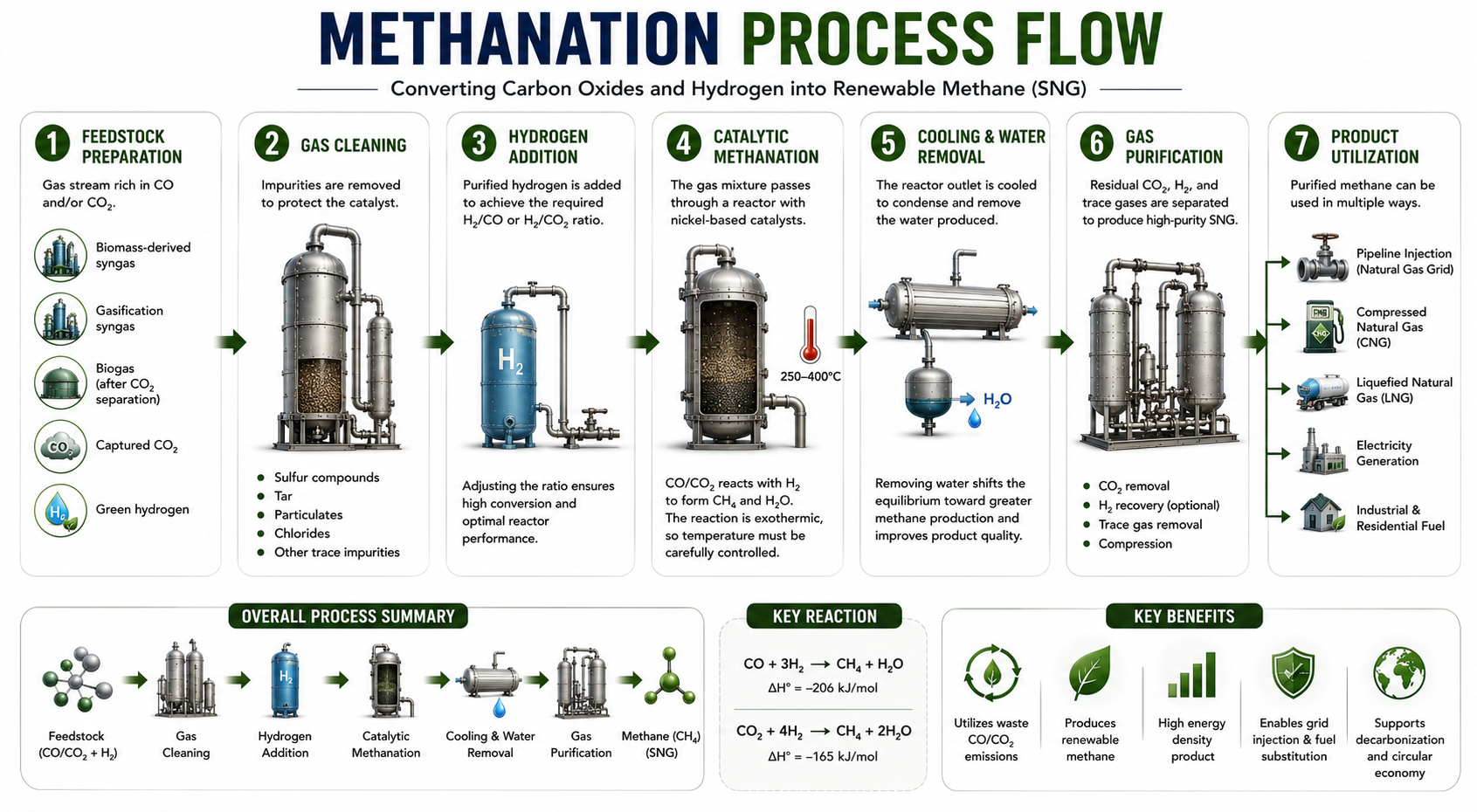
The methanation process consists of several interconnected stages.
1. Feedstock Preparation
The process begins with a gas stream rich in carbon monoxide (CO) and/or carbon dioxide (CO₂).
Common feedstocks include:
- Biomass-derived syngas
- Gasification syngas
- Biogas (after CO₂ separation)
- Captured CO₂
- Green hydrogen
2. Gas Cleaning
Before entering the reactor, impurities such as:
- Sulfur compounds
- Tar
- Particulates
- Chlorides
are removed to protect the catalyst from deactivation.
3. Hydrogen Addition
If required, purified hydrogen is added to achieve the desired H₂/CO or H₂/CO₂ ratio needed for efficient methane production.
4. Catalytic Methanation
The gas mixture passes through a fixed-bed or fluidized-bed reactor containing nickel-based catalysts.
At 250–400°C, carbon oxides react with hydrogen to form methane and water.
Because the reaction releases significant heat, reactor temperature must be carefully controlled to prevent catalyst degradation.
5. Cooling and Water Removal
The reactor outlet is cooled to condense and remove the water produced during methanation.
Removing water shifts the reaction toward greater methane production and improves product quality.
6. Gas Purification
Residual carbon dioxide, hydrogen, and trace gases are separated if necessary to produce high-purity Synthetic Natural Gas (SNG).
7. Product Utilization
The purified methane can be:
- Injected into natural gas pipelines
- Compressed as renewable CNG
- Liquefied as renewable LNG
- Used for electricity generation
- Used as industrial or residential fuel
Feedstock Options
- Biomass-Derived Syngas – Produced from the gasification of forestry and agricultural residues
- Biogas – Upgraded biogas containing methane and carbon dioxide from anaerobic digestion
- Captured Carbon Dioxide (CO₂) – Industrial flue gases, biogenic CO₂, or direct air capture
- Green Hydrogen (H₂) – Produced via water electrolysis using renewable electricity
- Municipal Solid Waste (MSW)-Derived Syngas – Syngas generated from the gasification of organic and combustible waste
- Industrial Process Gases – Carbon monoxide and carbon dioxide-rich gases from steel, cement, and chemical industries
Key Operating Parameters
|
Parameter |
Typical Range |
Influence on Process |
|
Temperature |
250–400°C |
Lower temperatures favor methane formation, while excessively high temperatures reduce catalyst performance. |
|
Pressure |
5–30 bar |
Higher pressures improve methane yield and overall conversion efficiency. |
|
H₂/CO or H₂/CO₂ Ratio |
Process dependent |
Adequate hydrogen is essential for complete conversion to methane. |
|
Catalyst |
Nickel-based (most common) |
Determines conversion efficiency, methane selectivity, and catalyst lifetime. |
|
Residence Time |
Seconds to minutes |
Sufficient contact time ensures high methane conversion. |
|
Gas Purity |
Low sulfur and particulates |
Cleaner gas protects catalysts and improves long-term operation. |
Why Methanation Matters
Methanation provides a practical pathway for converting renewable hydrogen and carbon-rich gases into Synthetic Natural Gas (SNG), enabling renewable energy to be stored, transported, and utilized using existing natural gas infrastructure. By linking biomass, carbon capture, and green hydrogen, methanation plays a key role in the transition toward a low-carbon energy system.
- Converts carbon monoxide and carbon dioxide into renewable methane, creating a direct substitute for fossil natural gas.
- Utilizes captured CO₂ and biomass-derived syngas, supporting carbon recycling and circular carbon utilization.
- Leverages existing natural gas pipelines and storage infrastructure, reducing the need for new distribution systems.
- Supports the decarbonization of industries and sectors where direct electrification is challenging.
- Provides a reliable renewable gas source for power generation, heating, and transportation.
Commercial Opportunity
Growing investments in renewable hydrogen, carbon capture, and renewable gas infrastructure are creating strong commercial opportunities for methanation technologies.
- Growing interest in Power-to-Gas (PtG) systems is driving demand for renewable methane as an energy storage solution.
- Increasing carbon capture and utilization (CCU) projects are creating new sources of carbon dioxide for methanation.
- Natural gas network operators are exploring renewable methane to decarbonize existing gas infrastructure.
- Rising demand for low-carbon fuels in transportation, industry, and heating is expanding markets for Synthetic Natural Gas.
- Government support for renewable gases and net-zero strategies continues to accelerate commercial deployment.
Key Challenges in Commercializing Methanation
- Hydrogen Availability and Cost
Large quantities of renewable hydrogen are required for methanation, making hydrogen production one of the biggest cost drivers. - Catalyst Performance and Lifetime
Nickel-based catalysts can lose activity due to sulfur poisoning, carbon deposition (coking), and high operating temperatures. - Gas Purification Requirements
Feed gases must be thoroughly cleaned to remove sulfur compounds, tar, particulates, and other impurities that can deactivate catalysts. - Heat Management
Methanation is a highly exothermic reaction, requiring efficient heat removal to prevent catalyst degradation and maintain stable operation. - High Capital Investment
Commercial plants require reactors, gas cleaning systems, hydrogen production or supply infrastructure, and gas purification units, resulting in high upfront costs. - Economic Competitiveness
Renewable methane must compete with low-cost fossil natural gas, making process efficiency and policy support critical for commercialization. - Policy and Infrastructure Support
Large-scale deployment depends on supportive renewable gas policies, carbon pricing, and infrastructure for hydrogen production, CO₂ capture, and natural gas grid integration.
Major Products Produced Through Methanation
|
End Product |
Typical Feedstock |
Primary Market |
|
Synthetic Natural Gas (SNG) |
Biomass-derived syngas, green H₂, captured CO₂ |
Natural gas grids, heating |
|
Renewable CNG (Bio-CNG) |
Synthetic methane |
Transportation fuels |
|
Renewable LNG (Bio-LNG) |
Synthetic methane |
Shipping, heavy transport |
|
Electricity & Heat |
Synthetic methane |
Power generation, industrial heating |
|
Industrial Fuel Gas |
Synthetic methane |
Steel, cement, chemical industries |
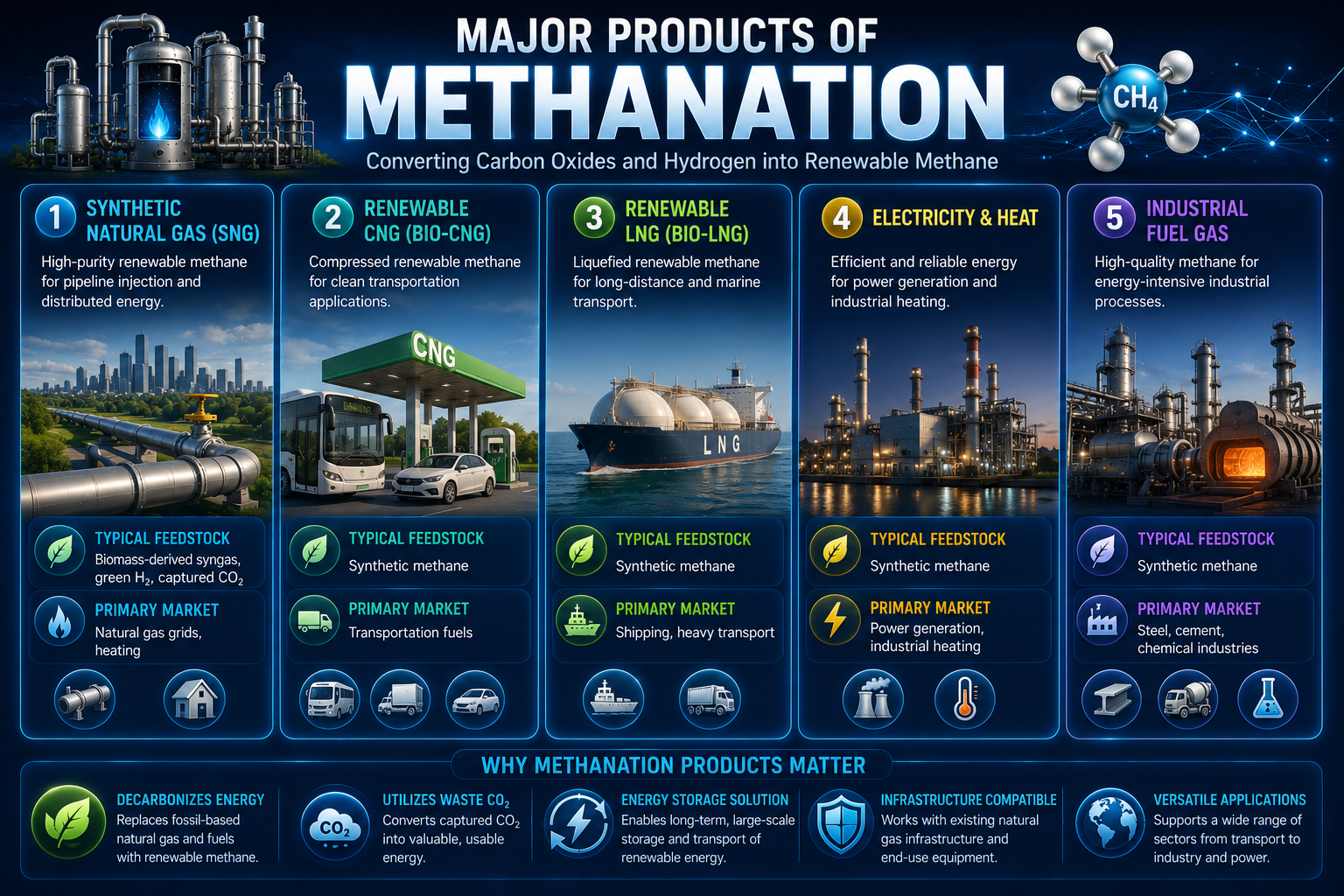
1. Synthetic Natural Gas (SNG)
Feedstock: Biomass-derived syngas, green hydrogen, captured CO₂
Process: CO/CO₂ + H₂ → Methanation → Synthetic Natural Gas
Synthetic Natural Gas (SNG) is the primary product of methanation. It has properties similar to fossil natural gas and can be transported through existing gas pipelines.
Key Applications: Natural gas grids, residential heating, industrial fuel
2. Renewable Compressed Natural Gas (Bio-CNG)
Feedstock: Upgraded biomethane, SNG
Process: Methanation → Gas Purification → Compression
Renewable methane can be compressed into Bio-CNG for use as a clean transportation fuel with lower greenhouse gas emissions than conventional fossil fuels.
Key Applications: Buses, trucks, passenger vehicles, public transport
3. Renewable Liquefied Natural Gas (Bio-LNG)
Feedstock: Synthetic methane
Process: Methanation → Liquefaction
Synthetic methane can be liquefied to produce Bio-LNG, enabling efficient storage and long-distance transport while serving sectors with high energy demands.
Key Applications: Heavy-duty transport, shipping, industrial energy
4. Electricity and Heat
Feedstock: Synthetic methane
Process: SNG → Gas Engine/Turbine → Electricity & Heat
Renewable methane can be combusted in gas turbines or combined heat and power (CHP) systems to generate electricity and useful thermal energy.
Key Applications: Power generation, district heating, industrial facilities
5. Industrial Fuel Gas
Feedstock: Synthetic methane
Process: Methanation → Gas Distribution
Methane produced through methanation can replace fossil natural gas in energy-intensive industries requiring high-temperature process heat.
Key Applications: Steel, cement, glass, ceramics, chemical manufacturing
Future Growth Drivers
The future of methanation will be driven by the rapid expansion of renewable hydrogen production and the increasing need for scalable energy storage and carbon utilization solutions.
- Expansion of carbon capture technologies will increase the availability of renewable carbon sources for methanation.
- Increasing adoption of Power-to-Gas systems will strengthen the role of methanation in balancing renewable electricity grids.
- Greater integration with biomass gasification and anaerobic digestion will expand renewable methane production pathways.
- Advances in catalyst development and reactor design will improve methane yields, energy efficiency, and process economics.
- Net-zero commitments, renewable gas policies, and industrial decarbonization efforts will continue to drive investment and commercialization of methanation technologies.