Microbial synthesis is a biological production technology that uses microorganisms such as bacteria, yeasts, fungi, and microalgae to manufacture fuels, chemicals, pharmaceuticals, enzymes, proteins, biomaterials, and other high-value products. By harnessing natural metabolic pathways or engineering microorganisms through synthetic biology and metabolic engineering, microbial synthesis enables the efficient conversion of renewable feedstocks into a wide range of sustainable bio-based products under controlled conditions.
With advances in genetic engineering, systems biology, precision fermentation, and bioprocess optimization, microbial synthesis has become a cornerstone of the modern bioeconomy. It enables the production of renewable alternatives to petroleum-derived products while supporting carbon utilization, waste valorization, and next-generation biomanufacturing. The following will be covered in the upcoming sections.
- The Chemistry Behind Microbial Synthesis
- Microbial Synthesis Process
- Feedstock Utilization
- Factors Affecting Product Yield
- Why Microbial Synthesis is Transforming the Future of Manufacturing
- Commercial Opportunity
- Key Challenges in Commercializing Microbial Synthesis
- Major Products Produced Through Microbial Synthesis
- Future Growth Drivers
The Chemistry Behind Microbial Synthesis
At the core of microbial synthesis is cellular metabolism, where microorganisms convert carbon sources into energy, biomass, and target products through enzyme-mediated reactions.
The process generally follows three stages:
1. Carbon Uptake
Microorganisms absorb carbon sources such as:
- Glucose
- Xylose
- Glycerol
- Acetate
- Carbon dioxide (photosynthetic microbes)
- Carbon monoxide and syngas (gas-fermenting microbes)
2. Metabolic Conversion
Inside the cell, the carbon source is converted into key metabolic intermediates through pathways such as:
- Glycolysis
- Pentose Phosphate Pathway
- Tricarboxylic Acid (TCA) Cycle
These intermediates provide both energy (ATP) and precursor molecules for biosynthesis.
3. Product Biosynthesis
Specific enzymes convert metabolic intermediates into the desired products, including:
- Biofuels
- Organic acids
- Amino acids
- Bioplastics
- Proteins
- Pharmaceuticals
- Specialty chemicals
In engineered microorganisms, synthetic biology redirects metabolic flux toward the target product while minimizing unwanted by-products.
Simplified Overall Reaction
Although the exact reaction depends on the product being synthesized, the process can be represented as:
Get in touch
Interested in biochar, bioplastics, biopolymers, or other bio-based business opportunities in India? Get expert guidance from our team
Call Muthu
Carbon Source + Nutrients + Microorganisms → Target Bioproduct + Biomass + CO₂ (or Other By-products)
How Microbial Synthesis Works
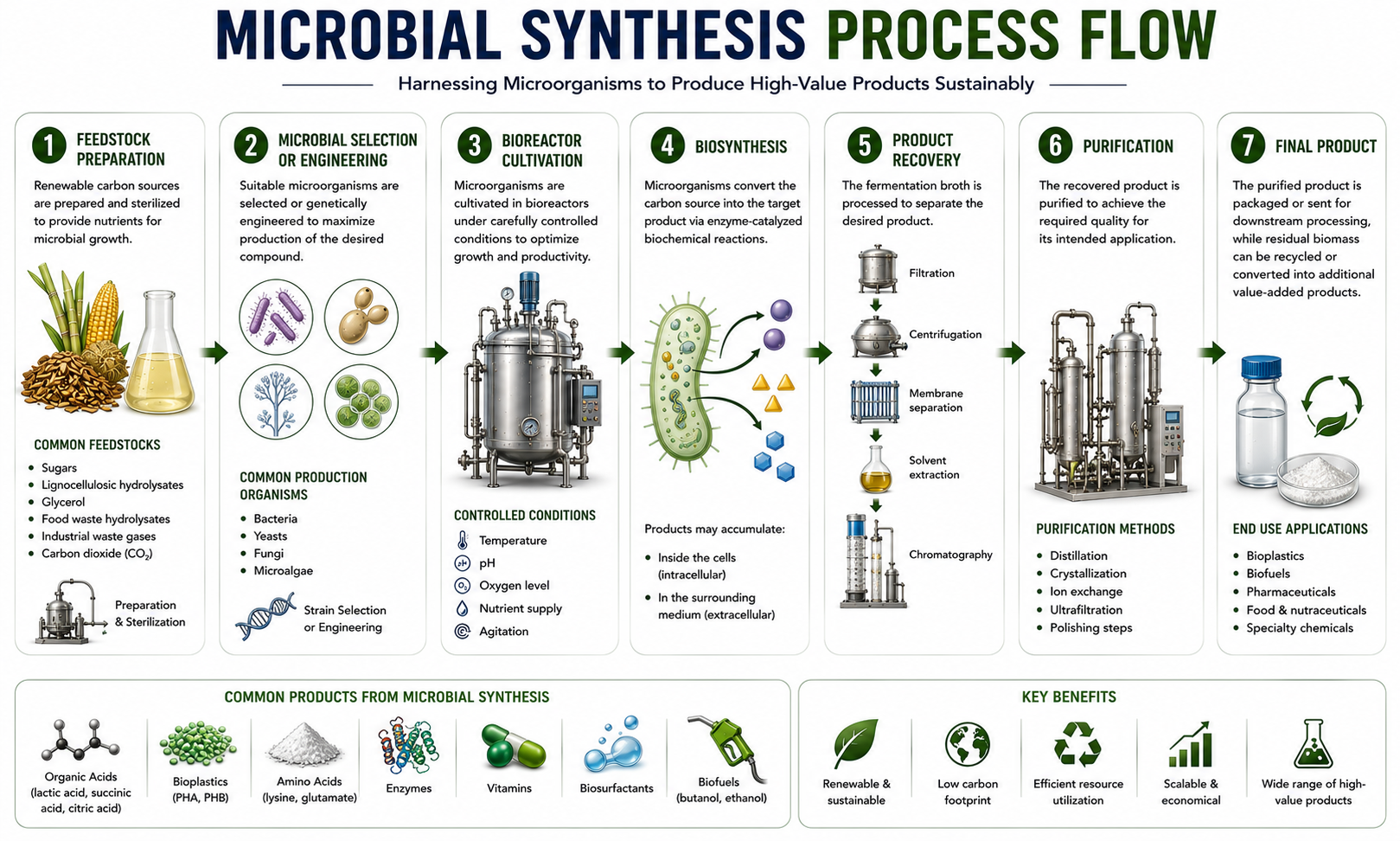
The microbial synthesis process consists of several interconnected biological and engineering stages.
1. Feedstock Preparation
Renewable carbon sources are prepared and sterilized to provide nutrients for microbial growth.
Common feedstocks include:
- Sugars
- Lignocellulosic hydrolysates
- Glycerol
- Food waste hydrolysates
- Industrial waste gases
- Carbon dioxide
2. Microbial Selection or Engineering
Suitable microorganisms are selected or genetically engineered to maximize production of the desired compound.
Common production organisms include:
- Bacteria
- Yeasts
- Fungi
- Microalgae
3. Bioreactor Cultivation
The microorganisms are cultivated in bioreactors under carefully controlled conditions, including:
- Temperature
- pH
- Oxygen level
- Nutrient supply
- Agitation
These conditions optimize microbial growth and product formation.
4. Biosynthesis
Using their metabolic pathways, microorganisms convert the supplied carbon source into the target product through enzyme-catalyzed biochemical reactions.
Depending on the microorganism and pathway, products may accumulate inside the cells or be secreted into the surrounding medium.
5. Product Recovery
The fermentation broth is processed to separate the desired product using techniques such as:
- Filtration
- Centrifugation
- Membrane separation
- Solvent extraction
- Chromatography
6. Purification
The recovered product is purified to achieve the required quality for industrial, pharmaceutical, food, or fuel applications.
7. Final Product
The purified product is packaged or sent for downstream processing, while residual biomass can often be recycled or converted into additional value-added products.
Feedstock Options
- Sugar-Based Feedstocks – Glucose, sucrose, molasses
- Lignocellulosic Hydrolysates – Cellulose- and hemicellulose-derived sugars from agricultural and forestry residues
- Glycerol – By-product of biodiesel production
- Industrial Waste Gases – Carbon monoxide (CO), carbon dioxide (CO₂), and syngas
- Food and Agricultural Waste – Food waste hydrolysates, fruit waste, whey, and agro-industrial by-products
- Algal Biomass – Microalgae-derived carbohydrates and lipids
- One-Carbon Feedstocks (C1) – Methane, methanol, and captured CO₂ (using specialized microorganisms)
Key Operating Parameters
|
Parameter |
Typical Range |
Influence on Process |
|
Temperature |
25–37°C (organism dependent) |
Controls microbial growth rate and enzyme activity. |
|
pH |
5.0–7.5 (organism dependent) |
Maintains optimal metabolic activity and product formation. |
|
Oxygen Supply |
Aerobic or anaerobic |
Determines metabolic pathway and influences product yield. |
|
Carbon Source |
Sugars, glycerol, CO₂, syngas |
Primary substrate for microbial growth and biosynthesis. |
|
Nutrient Availability |
Nitrogen, phosphorus, trace minerals |
Supports cell growth and product formation. |
|
Residence Time |
Hours to several days |
Affects biomass growth, productivity, and final product yield. |
Why Microbial Synthesis is Transforming the Future of Manufacturing
Microbial synthesis represents a fundamental shift in how products are manufactured. Instead of relying on finite fossil resources or energy-intensive chemical processes, it uses living microorganisms as programmable biological factories capable of converting renewable carbon into an extraordinary range of products. Advances in synthetic biology, metabolic engineering, and artificial intelligence are rapidly expanding what these microorganisms can produce, positioning microbial synthesis as one of the defining technologies of the modern bioeconomy.
Its transformative potential lies in several key advantages:
- Programmable Living Factories
Microorganisms can be genetically engineered to manufacture specific fuels, chemicals, proteins, pharmaceuticals, enzymes, and biomaterials with remarkable precision, allowing a single production platform to generate thousands of different products. - Feedstock Flexibility
Unlike conventional manufacturing, microbial synthesis can utilize renewable sugars, agricultural residues, food waste, industrial waste gases, glycerol, methane, and even captured carbon dioxide, turning low-value resources into high-value products. - Reduced Dependence on Fossil Resources
By replacing petroleum-derived feedstocks with renewable biological carbon, microbial synthesis offers a sustainable pathway for manufacturing fuels, plastics, chemicals, and specialty materials while lowering greenhouse gas emissions. - Rapid Innovation Through Synthetic Biology
Modern gene editing, metabolic engineering, and AI-driven strain design enable microorganisms to be optimized faster than ever before, accelerating the development of entirely new bio-based products and manufacturing processes. - Supports a Circular Bioeconomy
Waste streams from agriculture, industry, and municipalities can become valuable raw materials, reducing waste generation while recovering carbon and nutrients for productive use. - Scalable Across Multiple Industries
The same core technology can be applied across energy, chemicals, pharmaceuticals, food, agriculture, textiles, cosmetics, and advanced materials, making microbial synthesis one of the most versatile manufacturing platforms ever developed.
Commercial Opportunity
Rapid advances in biotechnology and growing demand for sustainable products are positioning microbial synthesis as one of the fastest-growing segments of the global bioeconomy.
- Increasing demand for bio-based chemicals, bioplastics, and specialty materials is expanding industrial applications.
- Growth of precision fermentation is creating new markets for food ingredients, alternative proteins, and high-value consumer products.
- Expanding biopharmaceutical and enzyme industries continue to drive investment in microbial manufacturing platforms.
- Industrial biotechnology is replacing petrochemical production for a growing number of chemicals and intermediates.
- AI-driven strain engineering and synthetic biology are accelerating product development while reducing manufacturing costs.
- Government support for sustainable manufacturing and biotechnology is encouraging investment in next-generation bioprocessing facilities.
Key Challenges in Commercializing Microbial Synthesis
- Feedstock Cost and Availability
Securing affordable, sustainable, and consistent carbon sources is critical for reducing production costs and improving process economics. - Microbial Strain Performance
Developing robust microorganisms with high productivity, product selectivity, and tolerance to inhibitors remains a major challenge. - Scale-Up and Process Optimization
Maintaining consistent microbial performance when scaling from laboratory to industrial bioreactors requires precise control of operating conditions. - Downstream Processing
Recovering and purifying bioproducts can be technically complex and often represents a significant portion of total production costs. - Genetic Stability
Engineered microorganisms may lose productivity or genetic traits over extended production cycles, affecting long-term process reliability. - Economic Competitiveness
Bio-based products must compete with established petrochemical manufacturing, requiring improvements in yield, productivity, and process efficiency. - Regulatory Approval and Market Adoption
Commercialization of genetically engineered microorganisms and novel bio-based products requires regulatory compliance, public acceptance, and supportive policy frameworks.
Major Products Produced Through Microbial Synthesis
|
End Product |
Typical Feedstock |
Primary Market |
|
Bioethanol |
Sugars, lignocellulosic hydrolysates, molasses |
Transportation fuels |
|
Bioplastics (PHA) |
Sugars, glycerol, plant oils |
Packaging, biodegradable plastics |
|
Industrial Enzymes |
Sugars, agricultural by-products |
Food, detergents, textiles, biorefineries |
|
Pharmaceutical Proteins & Biopharmaceuticals |
Sugars, defined nutrient media |
Healthcare, biotechnology |
|
Specialty Chemicals |
Sugars, glycerol, industrial waste gases |
Chemicals, pharmaceuticals, bioplastics |
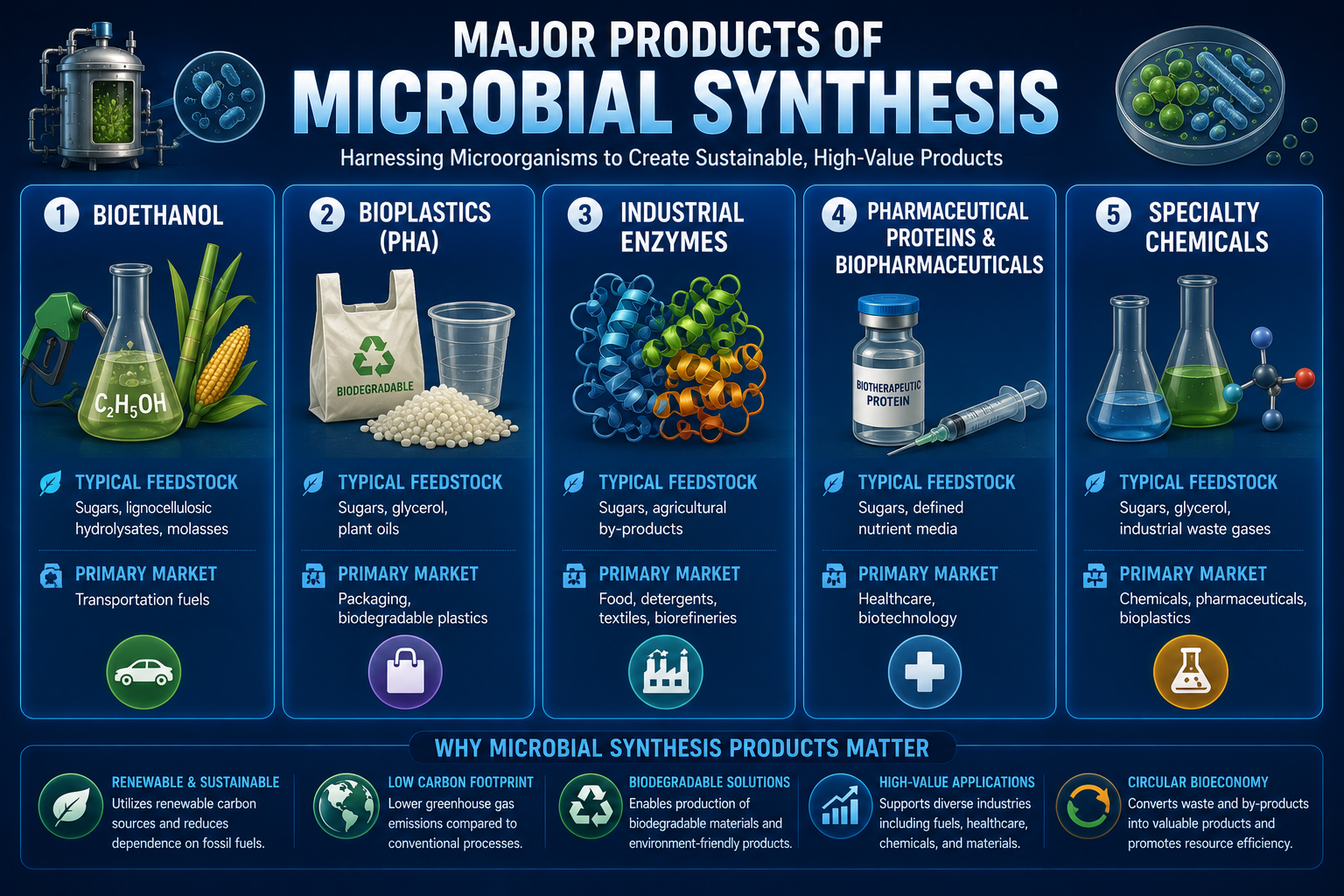
1. Bioethanol
Feedstock: Sugars, lignocellulosic hydrolysates, molasses
Process: Carbon Source → Microbial Synthesis → Bioethanol
Bioethanol is one of the largest-volume products produced through microbial synthesis and is widely used as a renewable transportation fuel and fuel additive.
Key Applications: Transportation fuels, fuel blending, industrial solvents
2. Bioplastics (PHA)
Feedstock: Sugars, glycerol, plant oils, waste streams
Process: Carbon Source → Microbial Synthesis → Polyhydroxyalkanoates (PHA)
Certain bacteria accumulate biodegradable polymers such as polyhydroxyalkanoates (PHA), providing sustainable alternatives to conventional plastics.
Key Applications: Packaging, medical devices, biodegradable consumer products
3. Industrial Enzymes
Feedstock: Sugars, agricultural by-products
Process: Carbon Source → Microbial Synthesis → Enzyme Production
Microorganisms produce enzymes used across multiple industries, including food processing, detergents, textiles, pulp and paper, and biofuel production.
Key Applications: Food, detergents, textiles, paper, biorefineries
4. Pharmaceutical Proteins and Biopharmaceuticals
Feedstock: Sugars, defined nutrient media
Process: Engineered Microorganisms → Protein Biosynthesis
Genetically engineered microorganisms manufacture high-value therapeutic proteins, vaccines, hormones, and other pharmaceutical products.
Key Applications: Pharmaceuticals, biotechnology, healthcare
5. Specialty Chemicals
Feedstock: Sugars, glycerol, industrial waste gases
Process: Microbial Synthesis → Biochemical Production
Engineered microbes produce a wide range of specialty chemicals that serve as renewable alternatives to petrochemical products.
Examples of Products:
- Succinic acid
- Lactic acid
- 1,3-Propanediol
- 1,4-Butanediol
Key Applications: Bioplastics, solvents, resins, pharmaceuticals, specialty chemicals
Future Growth Drivers
The future of microbial synthesis will be driven by advances in biotechnology and the growing demand for sustainable alternatives to conventional manufacturing.
- Advances in synthetic biology, metabolic engineering, and gene editing will enable microorganisms to produce increasingly complex and valuable products.
- Artificial intelligence and computational biology will accelerate strain design, process optimization, and commercialization.
- Growing availability of renewable and waste-derived carbon feedstocks will reduce production costs while supporting circular manufacturing.
- Rising demand for bio-based materials, sustainable chemicals, and alternative proteins will continue to expand commercial markets.
- Greater integration with biorefineries and carbon capture technologies will improve resource efficiency and broaden feedstock utilization.
- Global decarbonization strategies and the transition toward a circular bioeconomy will continue to drive investment in microbial biomanufacturing as a next-generation industrial platform.