Pyrolysis is a thermochemical conversion process in which organic materials are heated to elevated temperatures in the complete or near-complete absence of oxygen. Unlike combustion, where oxygen enables the complete oxidation of biomass into carbon dioxide and water, pyrolysis decomposes complex organic molecules into smaller compounds through thermal cracking. This results in the simultaneous production of three valuable product streams: a liquid fraction (bio-oil), a solid carbon-rich residue (biochar), and a gaseous fraction (syngas).
The technology forms one of the three principal thermochemical pathways for biomass conversion, alongside gasification and combustion, and serves as a critical platform for producing renewable fuels, bio-based chemicals, carbon materials, and negative-emission products. The following will be covered in the coming sections.
- The Chemistry Behind Pyrolysis
- Pyrolysis Process
- Feedstock Utilization
- Factors Affecting Product Yield
- Why Pyrolysis is the Preferred Thermochemical Conversion Technology
- Why Pyrolysis Matters
- Commercial Opportunity
- Key Challenges in Commercializing Pyrolysis
- Major Products Produced Through Pyrolysis
- Future outlook
Chemistry Behind Pyrolysis
Pyrolysis involves the thermal decomposition of biomass in the absence of oxygen, where heat breaks the chemical bonds of complex biopolymers into simpler molecules. Biomass is primarily composed of cellulose, hemicellulose, and lignin, which undergo thermal cracking, depolymerization, and deoxygenation reactions when heated. These reactions produce three major product streams: condensable vapors (bio-oil), non-condensable gases (syngas), and a carbon-rich solid residue (biochar).
Unlike conventional chemical reactions, pyrolysis does not have a single balanced equation because biomass is a complex mixture of organic compounds. A simplified representation of the overall process is:
Biomass + Heat (No O₂) → Bio-oil + Biochar + Syngas
The proportion of each product depends on factors such as temperature, heating rate, vapor residence time, and feedstock composition. Moderate temperatures and rapid heating generally favor bio-oil production, while lower temperatures increase biochar yield and higher temperatures promote syngas formation.
Get in touch
Interested in biochar, bioplastics, biopolymers, or other bio-based business opportunities in India? Get expert guidance from our team
Call Muthu
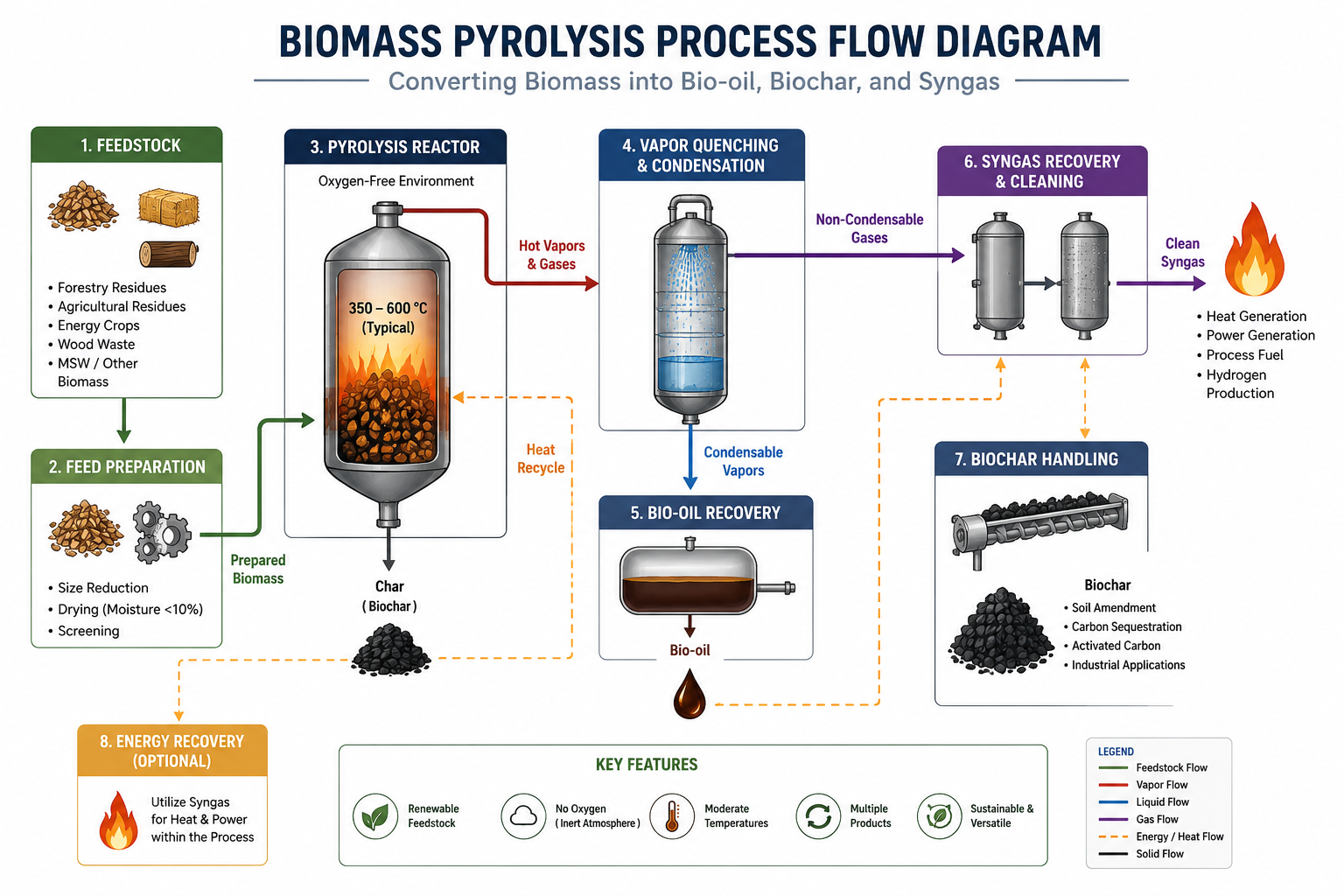
How Pyrolysis Works
The pyrolysis process can be understood as a sequence of interconnected physical and chemical transformations.
1. Heat Transfer
Prepared biomass is introduced into a reactor where heat is transferred rapidly or gradually, depending on the reactor design. Heat may be supplied through hot reactor walls, heated inert solids such as sand, circulating gases, microwaves, or concentrated solar energy..
2. Drying
Before significant chemical decomposition begins, residual moisture present within the biomass evaporates. Most commercial systems require moisture contents below 10–15% to maximize thermal efficiency and improve bio-oil quality.
3. Thermal Decomposition
As temperature increases, the chemical bonds holding together cellulose, hemicellulose, and lignin begin to break. Long-chain polymers fragment into thousands of smaller molecules through reactions such as depolymerization, cracking, dehydration, decarboxylation, demethoxylation, and deoxygenation.
These reactions produce a mixture of:
- Permanent gases
- Condensable vapors
- Solid carbonaceous material
The exact proportions depend on reactor conditions.
4. Vapor Formation
The volatile molecules generated during decomposition exit the reactor almost immediately as hot vapors. These vapors contain hundreds of oxygenated organic compounds including aldehydes, ketones, phenols, alcohols, acids, sugars, and hydrocarbons.
If these vapors remain at high temperatures for extended periods, they undergo secondary cracking reactions that increase gas production while reducing liquid yield.
5. Condensation
The hot vapors are rapidly cooled in condensers. Fast quenching minimizes secondary reactions and converts condensable vapors into liquid bio-oil, while non-condensable gases remain in the gaseous phase as syngas.
6. Biochar Formation
Not all biomass volatilizes during heating. A fraction of the original carbon remains as a porous solid residue known as biochar. The amount produced depends on biomass composition and operating conditions.
Feedstock Options
- Agricultural Residues – Rice husk, wheat straw, corn stover, sugarcane bagasse
- Forestry Residues – Wood chips, sawdust, bark, logging residues
- Energy Crops – Switchgrass, miscanthus, short-rotation woody crops
- Municipal Organic Waste – Organic fraction of municipal solid waste (OFMSW), food waste
- Industrial Biomass Waste – Paper sludge, pulp residues, black liquor
- Sewage Sludge & Biosolids – Municipal and industrial wastewater treatment sludge
- Animal Waste – Poultry litter, cattle manure
- Algal Biomass – Microalgae and macroalgae (emerging feedstock)
Key Operating Parameters
The distribution of pyrolysis products is governed by several interdependent process variables.
|
Parameter |
Typical Range |
Influence on Products |
|
Temperature |
300–700°C (typically 450–550°C for fast pyrolysis) |
Higher temperatures generally increase gas production, while moderate temperatures maximize liquid yields. |
|
Heating Rate |
0.1–1,000°C/s |
Rapid heating promotes bio-oil formation, whereas slow heating favors biochar production. |
|
Vapor Residence Time |
Less than 2 seconds (fast pyrolysis) to several minutes (slow pyrolysis) |
Short residence times minimize secondary cracking and maximize bio-oil yield. |
|
Biomass Particle Size |
Typically <2–5 mm for fast pyrolysis |
Smaller particles improve heat transfer and ensure more uniform conversion. |
|
Moisture Content |
Ideally <10–15 wt.% |
High moisture reduces reactor efficiency and lowers bio-oil quality by increasing water content. |
|
Reactor Pressure |
Usually atmospheric, though vacuum or pressurized systems exist |
Pressure influences vapor behavior, residence time, and product composition. |
Why Pyrolysis is the Preferred Thermochemical Conversion Technology
Pyrolysis is widely preferred because it can convert a broad range of biomass into multiple high-value products—bio-oil, biochar, and syngas—under relatively moderate operating conditions. Its flexibility, ability to utilize waste biomass, and potential to produce renewable fuels, bio-based chemicals, and carbon-negative materials make it one of the most versatile and sustainable thermochemical conversion technologies available today.
Why Pyrolysis Matters
Pyrolysis is more than a biomass conversion technology—it is a platform for transforming low-value biomass and organic waste into renewable fuels, carbon materials, and high-value chemicals.
- Converts waste into valuable products, reducing landfill use and open-field biomass burning.
- Produces multiple revenue streams through bio-oil, biochar, syngas, and renewable chemicals.
- Supports decarbonization by replacing fossil-derived fuels and enabling long-term carbon storage through biochar.
- Compatible with diverse feedstocks, including agricultural residues, forestry waste, and municipal biomass.
- Integrates with modern biorefineries, supplying intermediates for sustainable fuels and bio-based chemicals.
- Contributes to circular economy goals by recovering energy and materials from biomass that would otherwise be discarded.
Commercial Opportunity
The commercialization of pyrolysis is being driven by the growing demand for renewable fuels, carbon removal technologies, and sustainable waste management solutions.
- Rapidly expanding demand for Sustainable Aviation Fuel (SAF) and renewable diesel is increasing interest in bio-oil upgrading.
- Carbon credit markets are creating new revenue opportunities through biochar-based carbon sequestration.
- Agricultural waste management presents a significant opportunity, particularly in regions with large volumes of crop residues.
- Industrial decarbonization is driving the adoption of renewable carbon feedstocks for chemical manufacturing.
- Government incentives and renewable fuel policies continue to improve investment attractiveness worldwide.
- Growing private investment in advanced biofuels and carbon removal is accelerating commercialization of pyrolysis technologies.
Key Challenges in Commercializing Pyrolysis
- Reliable Feedstock Supply
Seasonal availability, inconsistent biomass quality, and high logistics costs make securing a continuous feedstock supply a major commercial challenge. - Bio-oil Quality and Stability
Raw bio-oil is acidic, oxygen-rich, and chemically unstable, requiring upgrading before it can be used as transportation fuel. - Commercial Scale-Up
Scaling pyrolysis from pilot plants to large commercial facilities while maintaining efficient heat transfer and consistent product quality remains challenging. - Market Development for Products
Expanding reliable markets for bio-oil, biochar, and syngas is essential to improve project profitability and long-term commercial viability. - Economic Competitiveness
High capital costs and competition from fossil fuels require improved process efficiency, product diversification, and supportive economic incentives. - Policy and Sustainability Compliance
Commercial deployment depends on clear regulations, renewable fuel standards, carbon accounting, and sustainability certification frameworks.
Major Products Produced Through Pyrolysis
|
End Product |
Typical Feedstock |
Primary Market |
|
Sustainable Aviation Fuel (SAF) |
Forestry and agricultural residues |
Aviation |
|
Renewable Diesel |
Woody biomass and crop residues |
Road transport and heavy vehicles |
|
Biochar |
Agricultural waste, wood waste, manure |
Agriculture, carbon removal, water treatment |
|
Renewable Chemicals |
Lignocellulosic biomass |
Chemical and materials industries |
|
Green Hydrogen & Syngas Products |
Biomass residues |
Energy, chemicals, industrial Processes |
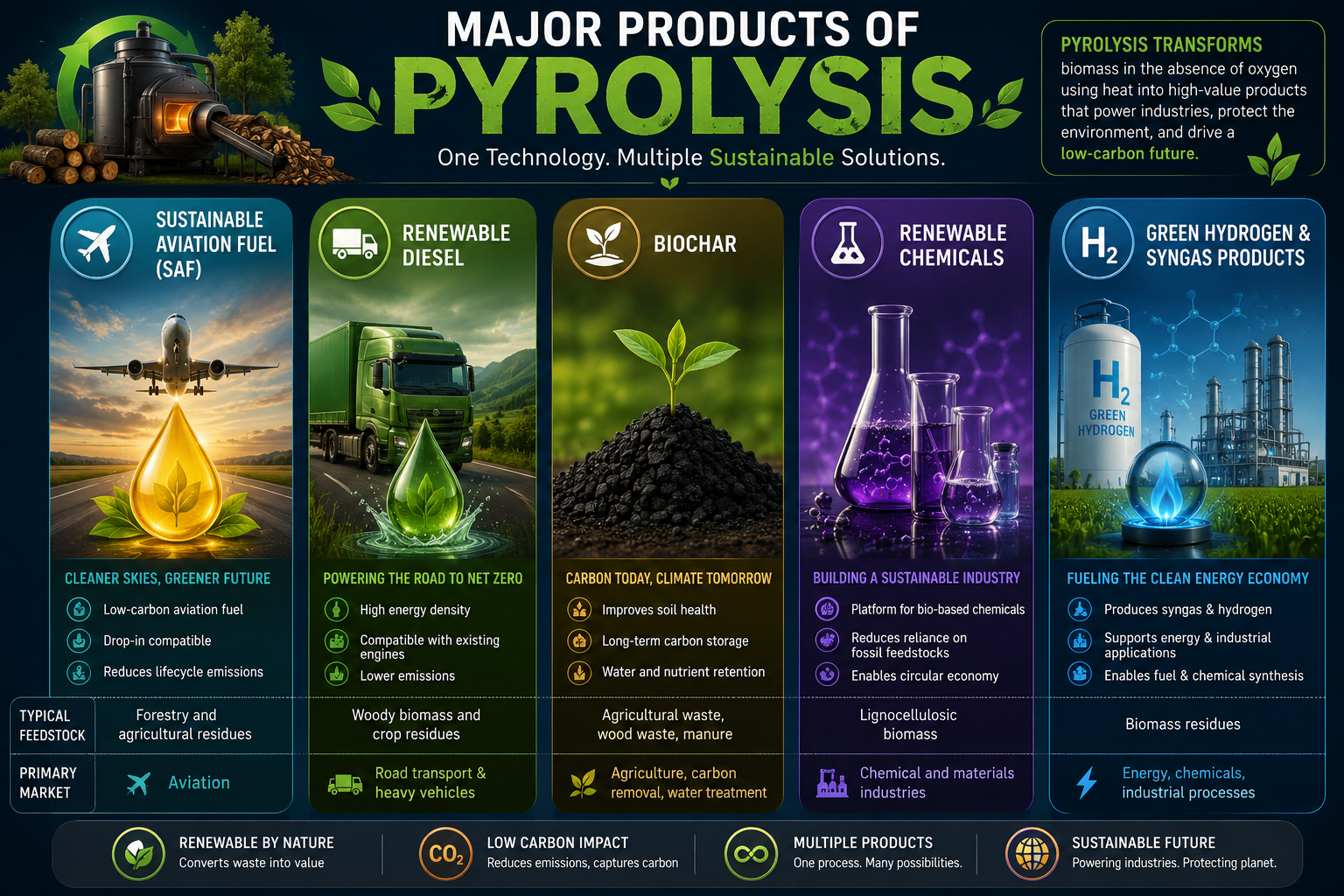
1. Sustainable Aviation Fuel (SAF)
Feedstock: Forestry residues, agricultural waste, energy crops
Process: Fast pyrolysis → Bio-oil → Hydrotreating → SAF
One of the fastest-growing applications of pyrolysis is the production of Sustainable Aviation Fuel (SAF). Fast pyrolysis converts lignocellulosic biomass into bio-oil, which is subsequently upgraded through catalytic hydrotreating and refining into aviation fuel that can be blended with conventional jet fuel. This pathway offers a promising solution for reducing aviation emissions while utilizing low-value biomass residues.
Key Applications: Commercial aviation, military aviation
2. Renewable Diesel
Feedstock: Wood residues, sawdust, crop residues
Process: Fast pyrolysis → Bio-oil → Hydroprocessing → Renewable Diesel
Pyrolysis-derived bio-oil can be upgraded into renewable diesel, a drop-in fuel chemically similar to petroleum diesel. Unlike biodiesel, renewable diesel requires no engine modifications and is fully compatible with existing fuel infrastructure.
Key Applications: Heavy-duty trucks, buses, mining equipment, marine transport
3. Biochar
Feedstock: Agricultural residues, forestry waste, manure, biosolids
Process: Slow pyrolysis → Biochar
Biochar is a stable, carbon-rich solid produced during pyrolysis. Beyond improving soil fertility and water retention, biochar has emerged as one of the leading carbon removal technologies because it can lock carbon in soils for hundreds to thousands of years. It is also used in activated carbon production, water treatment, and construction materials.
Key Applications: Agriculture, carbon sequestration, water filtration, building materials
4. Renewable Chemicals
Feedstock: Lignocellulosic biomass
Process: Fast pyrolysis → Bio-oil → Chemical Separation & Refining
Pyrolysis bio-oil contains numerous valuable platform chemicals that can be extracted or upgraded into industrial products. These include phenols for resins and adhesives, acetic acid for chemicals manufacturing, furfural for solvents and polymers, and levoglucosan for specialty chemicals and biobased materials.
Examples of Products:
- Phenol
- Acetic acid
- Furfural
- Levoglucosan
- Guaiacol
Key Applications: Chemical manufacturing, pharmaceuticals, polymers, resins
5. Green Hydrogen and Syngas-Based Products
Feedstock: Biomass residues
Process: Pyrolysis → Syngas → Gas Cleaning & Reforming
The non-condensable gases produced during pyrolysis are rich in carbon monoxide, hydrogen, methane, and light hydrocarbons. After purification, syngas can be used directly for heat and power or further processed to produce green hydrogen, methanol, ammonia, and synthetic fuels.
Key Applications: Hydrogen production, chemical synthesis, industrial heating, electricity generation
Future Outlook
Pyrolysis is expected to evolve from a renewable fuel technology into an integrated platform for producing sustainable fuels, carbon materials, and specialty chemicals.
- Catalytic pyrolysis will improve bio-oil quality and reduce upgrading costs.
- AI-driven process optimization will enhance product yields, energy efficiency, and plant reliability.
- Greater integration with biorefineries will enable the production of multiple fuels and chemicals from a single feedstock.
- Expansion of biochar markets will strengthen carbon removal and sustainable agriculture initiatives.
- Scaling modular pyrolysis systems will enable decentralized biomass processing closer to feedstock sources.
- Increasing demand for low-carbon fuels and chemicals is expected to drive continued commercial growth over the coming decades.