
Torrefaction is a mild thermochemical pretreatment technology that upgrades biomass into a more energy-dense, hydrophobic, and coal-like solid fuel known as torrefied biomass or bio-coal. The process involves heating biomass to 200–300°C in the absence or near-absence of oxygen, driving off moisture and light volatile compounds while preserving most of the material’s energy content. Compared with raw biomass, torrefied biomass has improved grindability, storage stability, and combustion characteristics. As the demand for sustainable solid fuels and efficient biomass utilization continues to grow, torrefaction has emerged as an important technology for improving biomass logistics and enabling the replacement of fossil coal in power generation and industrial heating. The following will be covered in upcoming sections.
- The Chemistry Behind Torrefaction
- Torrefaction Process
- Feedstock Utilization
- Factors Affecting Product Yield
- Why Torrefaction Matters
- Commercial Opportunity
- Key Challenges in Commercializing Torrefaction
- Major Products Produced Through Torrefaction
- Future Growth Drivers
Chemistry Behind Torrefaction
Torrefaction is a mild thermal decomposition process in which biomass is heated to 200–300°C in the absence of oxygen. During heating, hemicellulose partially decomposes, while cellulose and lignin undergo only minor structural changes. This removes moisture and oxygen-rich volatile compounds, increasing the carbon content and energy density of the remaining solid biomass.
Unlike pyrolysis, torrefaction is primarily a devolatilization process rather than complete thermal decomposition. The released volatiles mainly include water vapor (H₂O), carbon dioxide (CO₂), carbon monoxide (CO), acetic acid (CH₃COOH), and light organic compounds, leaving behind a carbon-rich solid known as torrefied biomass (bio-coal).
A simplified representation of the process is:
Biomass + Heat (200–300°C, No O₂) → Torrefied Biomass + H₂O + CO₂ + CO + Light Volatile Organics
The extent of these reactions depends on temperature and residence time, with higher temperatures producing a more carbon-rich, hydrophobic, and energy-dense fuel.
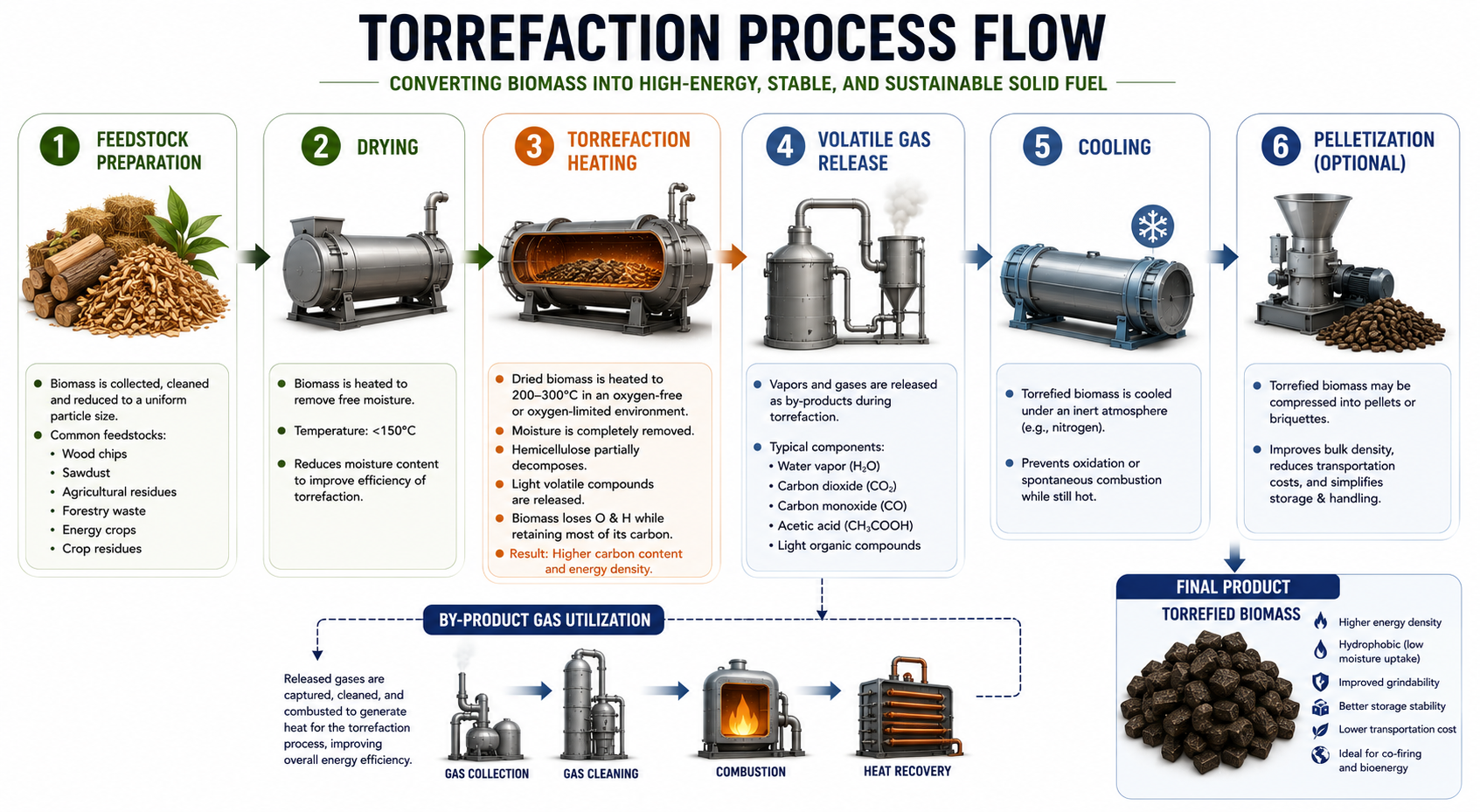
How Torrefaction Works
The torrefaction process consists of a series of physical and chemical transformations.
1. Feedstock Preparation
Biomass is collected, cleaned, and reduced to a suitable particle size to ensure uniform heating.
Get in touch
Interested in biochar, bioplastics, biopolymers, or other bio-based business opportunities in India? Get expert guidance from our team
Call Muthu
Common feedstocks include:
- Wood chips
- Sawdust
- Agricultural residues
- Forestry waste
- Energy crops
- Crop residues
2. Drying
Before torrefaction begins, the biomass is heated to remove free moisture.
This typically occurs below 150°C, reducing the moisture content to improve process efficiency.
3. Torrefaction Heating
The dried biomass enters a reactor where it is heated to 200–300°C under oxygen-free or oxygen-limited conditions.
At these temperatures:
- Moisture is completely removed.
- Hemicellulose partially decomposes.
- Light volatile compounds are released.
- The biomass loses oxygen and hydrogen while retaining most of its carbon.
This results in a solid fuel with a higher carbon concentration and greater energy density.
4. Volatile Gas Release
The released vapors contain:
- Water vapor
- Carbon dioxide (CO₂)
- Carbon monoxide (CO)
- Acetic acid
- Light organic compounds
Many commercial systems recover and combust these gases to provide heat for the torrefaction process, improving overall energy efficiency.
5. Cooling
The torrefied biomass is cooled under an inert atmosphere to prevent oxidation or spontaneous combustion while still hot.
6. Pelletization (Optional)
The torrefied biomass may be compressed into torrefied pellets or briquettes.
Pelletization improves bulk density, reduces transportation costs, and simplifies storage and handling.
Feedstock Options
- Forestry Residues – Wood chips, sawdust, bark, logging residues
- Agricultural Residues – Rice husk, wheat straw, corn stover, sugarcane bagasse
- Energy Crops – Switchgrass, miscanthus, willow, poplar
- Wood Processing Waste – Wood pellets, plywood waste, furniture waste
- Municipal Green Waste – Tree trimmings, yard waste, garden residues
- Industrial Biomass Residues – Paper sludge, pulp residues, biomass processing waste
Key Operating Parameters
|
Parameter |
Typical Range |
Influence on Process |
|
Temperature |
200–300°C |
Higher temperatures increase energy density but reduce solid yield. |
|
Residence Time |
20–60 minutes |
Longer residence times enhance biomass upgrading but increase mass loss. |
|
Heating Rate |
Slow to moderate |
Ensures uniform heating and controlled decomposition. |
|
Particle Size |
Typically 5–50 mm |
Smaller particles improve heat transfer and process uniformity. |
|
Moisture Content |
Ideally <15 wt.% |
Lower moisture improves energy efficiency and product quality. |
|
Atmosphere |
Oxygen-free or inert |
Prevents combustion and enables controlled thermal decomposition. |
Why Torrefaction Matters
Torrefaction enhances the fuel quality of biomass, making it easier to transport, store, and utilize as a renewable alternative to coal. By upgrading low-density biomass into a stable, energy-dense solid fuel, it addresses one of the biggest challenges in biomass-based energy systems—efficient logistics and utilization.
- Upgrades raw biomass into a coal-like renewable fuel with higher energy density and improved combustion properties.
- Reduces moisture content, improving storage stability and lowering transportation costs.
- Produces hydrophobic biomass, enabling long-term outdoor storage with minimal degradation.
- Improves grindability, allowing torrefied biomass to be co-fired with coal using existing power plant infrastructure.
- Serves as an effective pretreatment for downstream technologies such as gasification, pyrolysis, and combustion.
- Supports the transition away from coal by providing a renewable solid fuel compatible with existing industrial systems.
Commercial Opportunity
The global shift toward low-carbon energy and industrial decarbonization is creating new opportunities for torrefied biomass as a sustainable solid fuel.
- Growing demand for coal replacement fuels is driving interest in torrefied biomass for power generation and industrial heating.
- Expansion of biomass co-firing projects allows existing coal-fired plants to reduce emissions without major infrastructure changes.
- Increasing international trade in biomass pellets is creating demand for energy-dense torrefied pellets with superior handling properties.
- Industries such as cement, steel, and pulp and paper are exploring torrefied biomass to reduce fossil fuel consumption.
- Improved biomass logistics and storage enhance the economic viability of large-scale biomass supply chains.
- Government decarbonization policies and renewable energy targets are encouraging investment in advanced solid biofuels.
Key Challenges in Commercializing Torrefaction
- Feedstock Availability and Quality
Variations in biomass type, moisture content, and composition can affect torrefaction performance and product consistency. - Process Energy Demand
Although milder than pyrolysis, torrefaction still requires heat input, making efficient heat recovery essential for improving process economics. - Product Quality Consistency
Maintaining uniform energy density, moisture resistance, and mechanical strength is critical for meeting industrial fuel standards. - Dust Formation and Handling
Torrefied biomass is more brittle than raw biomass, increasing dust generation during handling, storage, and transportation. - Economic Competitiveness
High capital costs for torrefaction and pelletization facilities must be balanced against the economic benefits of improved fuel properties and reduced logistics costs. - Market Development
Wider adoption depends on expanding markets for torrefied biomass, particularly in coal co-firing, industrial heating, and biomass power generation. - Policy and Sustainability Support
Commercial growth requires supportive renewable energy policies, carbon reduction incentives, and sustainability certification for biomass feedstocks.
Major Products Produced Through Torrefaction
|
End Product |
Typical Feedstock |
Primary Market |
|
Torrefied Biomass (Bio-coal) |
Wood chips, agricultural residues, energy crops |
Power generation, industrial heating |
|
Torrefied Pellets |
Torrefied biomass |
Biomass power plants, export fuel markets |
|
Bio-coal Briquettes |
Forestry and agricultural residues |
Industrial boilers, cement plants |
|
Process Heat |
Torrefaction gases |
Industrial process heating |
|
Renewable Chemical Precursors |
Biomass-derived volatiles |
Chemical industry, specialty chemicals |
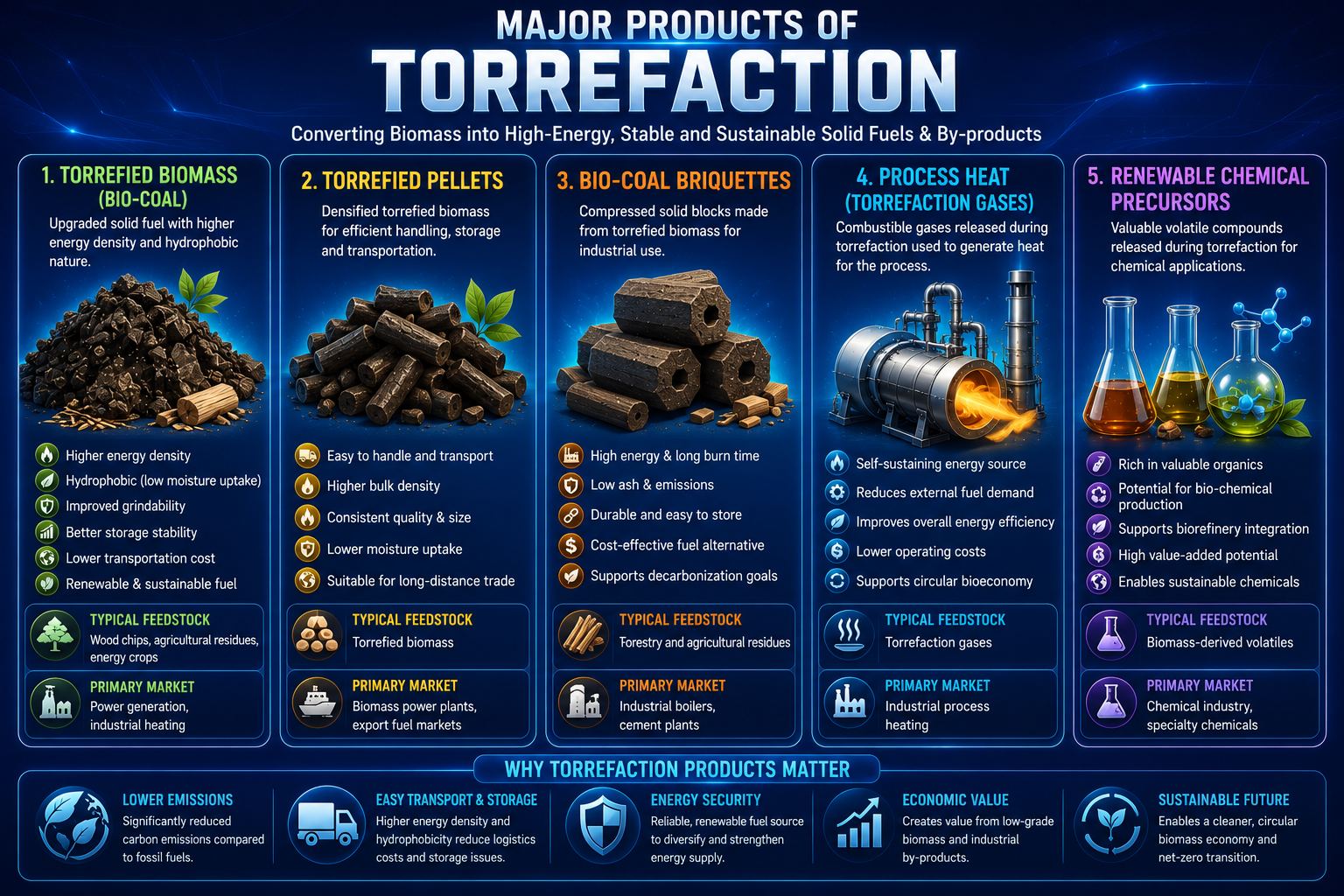
1. Torrefied Biomass (Bio-coal)
Feedstock: Wood chips, sawdust, agricultural residues, energy crops
Process: Biomass → Torrefaction → Torrefied Biomass
Torrefied biomass is the primary product of the process. It has higher energy density, lower moisture content, and improved grindability, making it an ideal substitute for coal.
Key Applications: Coal co-firing, biomass power plants, industrial boilers
2. Torrefied Pellets
Feedstock: Torrefied biomass
Process: Torrefaction → Pelletization
Torrefied biomass can be compressed into durable pellets with higher bulk density and excellent storage stability, reducing transportation and handling costs.
Key Applications: Power generation, industrial heating, export fuel markets
3. Bio-coal Briquettes
Feedstock: Agricultural residues, forestry residues
Process: Torrefaction → Briquetting
Torrefied biomass can also be densified into briquettes for use as a renewable solid fuel with combustion characteristics similar to coal.
Key Applications: Industrial furnaces, cement plants, domestic heating
4. Process Heat
Feedstock: Volatile gases released during torrefaction
Process: Volatile Gas Combustion → Heat Recovery
The volatile compounds released during torrefaction are often combusted to provide heat for the torrefaction reactor, improving overall energy efficiency.
Key Applications: Internal process heating, industrial thermal energy
5. Renewable Chemical Precursors
Feedstock: Condensable volatile compounds
Process: Torrefaction → Condensation of Volatiles
Small quantities of condensable organic compounds such as acetic acid, methanol, and light oxygenated compounds can be recovered, although their commercial value is generally lower than in pyrolysis.
Key Applications: Chemical intermediates, research and specialty chemicals
Future Growth Drivers
The future growth of torrefaction will be driven by the increasing need for high-quality renewable solid fuels that can seamlessly integrate with existing energy infrastructure.
- Accelerating coal phase-out initiatives will increase demand for renewable solid fuels compatible with existing power plants.
- Expansion of biomass co-firing and industrial decarbonization will strengthen markets for torrefied biomass and bio-coal.
- Growing international biomass trade will favor torrefied pellets due to their higher energy density and lower transportation costs.
- Advances in reactor design, heat recovery, and pelletization technologies will improve process efficiency and reduce production costs.
- Integration with gasification, pyrolysis, and biorefinery platforms will expand the role of torrefaction as a biomass pretreatment technology.
- Supportive carbon reduction policies and renewable energy incentives will continue to accelerate commercial adoption across the power and industrial sectors.