
Transesterification is the most widely used technology for producing biodiesel, converting vegetable oils, animal fats, used cooking oil, and other lipid-rich feedstocks into fatty acid alkyl esters (biodiesel) and glycerol through a catalytic reaction with methanol or ethanol. Its high conversion efficiency, relatively mild operating conditions, and compatibility with diverse feedstocks have made it the dominant commercial pathway for biodiesel production worldwide. The following will be covered in the coming sections.
- The Chemistry Behind Transesterification
- How Transesterification Works
- Feedstocks Options
- Factors Affecting Biodiesel Yield
- Why Transesterification is the Preferred Biodiesel Technology
- Why Transesterification Matters
- Key Challenges in Commercializing Transesterification
- Major Products Produced Through Transesterification
- Future Growth Drivers
The Chemistry Behind Transesterification
Most vegetable oils, animal fats, and waste cooking oils consist primarily of triglycerides—molecules composed of one glycerol backbone attached to three long-chain fatty acids.
During transesterification, these triglycerides react with an alcohol to form biodiesel and glycerol.
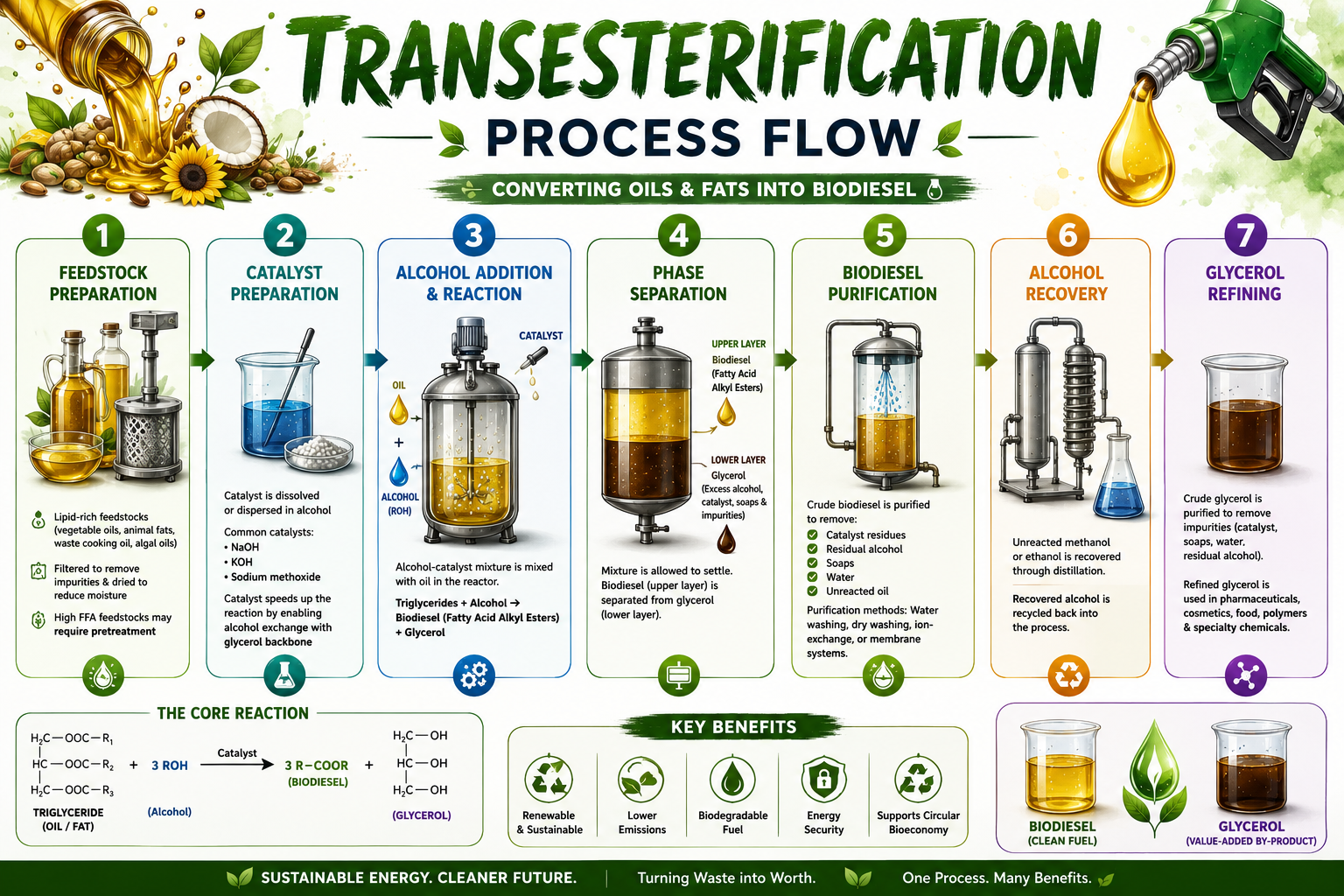
Triglyceride + 3 Alcohol → 3 Fatty Acid Alkyl Esters (Biodiesel) + Glycerol
Although the reaction appears simple, it occurs through a series of consecutive reversible reactions where triglycerides are gradually converted into diglycerides, monoglycerides, and finally glycerol, with one biodiesel molecule formed at each step.
How Transesterification Works
The transesterification process involves a sequence of chemical transformations that convert oils and fats into biodiesel.
1. Feedstock Preparation
The process begins with lipid-rich feedstocks such as vegetable oils, animal fats, waste cooking oil, or algal oils. Before entering the reactor, the feedstock is filtered to remove suspended solids and, if necessary, dried to reduce its moisture content.
For feedstocks containing high levels of free fatty acids (FFAs), an additional pretreatment step may be required to prevent undesirable side reactions during transesterification.
Get in touch
Interested in biochar, bioplastics, biopolymers, or other bio-based business opportunities in India? Get expert guidance from our team
Call Muthu
2. Catalyst Preparation
The catalyst is dissolved or dispersed in the alcohol before being mixed with the oil.
Commercial biodiesel production commonly uses:
- Sodium hydroxide (NaOH)
- Potassium hydroxide (KOH)
- Sodium methoxide
The catalyst increases the reaction rate by facilitating the exchange of the alcohol molecule with the glycerol backbone.
3. Alcohol Addition and Reaction
The prepared alcohol-catalyst mixture is introduced into the reactor and mixed with the oil.
Methanol is the most commonly used alcohol because of its high reactivity, low cost, and wide availability. Ethanol is also used in some regions due to its renewable origin.
Inside the reactor, triglycerides react with the alcohol, breaking the bonds between glycerol and fatty acids. The fatty acids combine with the alcohol to form biodiesel, while glycerol separates as a by-product.
Because the reaction is reversible, excess alcohol is typically added to drive the reaction toward maximum biodiesel production.
4. Phase Separation
After the reaction is complete, the mixture is allowed to settle.
Due to differences in density, two distinct layers form:
- Upper Layer: Biodiesel (Fatty Acid Alkyl Esters)
- Lower Layer: Glycerol containing excess alcohol, catalyst, soaps, and impurities
The glycerol-rich phase is removed for further purification or industrial utilization.
5. Biodiesel Purification
The crude biodiesel still contains traces of catalyst, residual alcohol, soaps, water, and unreacted oil.
Purification is carried out using water washing, dry washing, ion-exchange resins, or membrane-based systems to produce fuel that meets international biodiesel quality standards.
6. Alcohol Recovery
Unreacted methanol or ethanol is recovered through distillation and recycled back into the process.
Alcohol recovery significantly reduces operating costs while improving process sustainability.
7. Glycerol Refining
The crude glycerol produced during transesterification contains catalyst residues, water, soaps, and residual alcohol.
After purification, glycerol can be used as a feedstock for producing pharmaceuticals, cosmetics, food ingredients, polymers, and specialty chemicals.
Feedstock Options
The flexibility of transesterification allows a wide variety of lipid-rich feedstocks to be utilized.
Common feedstocks include:
- Soybean oil
- Rapeseed oil
- Palm oil
- Sunflower oil
- Canola oil
- Used cooking oil
- Animal fats
- Tallow
- Algal oil
- Non-edible oils such as Jatropha and Pongamia
The choice of feedstock influences biodiesel yield, fuel quality, operating costs, and overall sustainability.
Factors Affecting Biodiesel Yield
The efficiency of transesterification depends on several process parameters.
|
Parameter |
Typical Range |
Influence on Process |
|
Temperature |
50–65°C |
Higher temperatures accelerate the reaction but excessive heating may cause alcohol loss. |
|
Alcohol-to-Oil Ratio |
6:1 (Methanol:Oil) |
Excess alcohol shifts the reaction toward higher biodiesel conversion. |
|
Catalyst Concentration |
0.5–1.5 wt.% |
Insufficient catalyst lowers conversion, while excessive catalyst promotes soap formation. |
|
Reaction Time |
30–120 minutes |
Adequate time is required to achieve complete conversion of triglycerides. |
|
Mixing Intensity |
Moderate to vigorous |
Ensures efficient contact between immiscible oil and alcohol phases. |
|
Free Fatty Acid Content |
Ideally <2 wt.% |
High FFA levels increase soap formation and reduce biodiesel yield when using base catalysts. |
|
Moisture Content |
<0.05 wt.% |
Water promotes hydrolysis and soap formation, reducing process efficiency. |
Why Transesterification is the Preferred Biodiesel Technology
Transesterification has become the dominant commercial biodiesel production technology because it combines high conversion efficiency, relatively mild operating conditions, and compatibility with a wide range of feedstocks. The process can routinely achieve biodiesel conversion efficiencies exceeding 95–98% under optimized conditions while requiring comparatively low energy input.
Why Transesterification Matters
Transesterification is the most mature and commercially proven pathway for biodiesel production, providing a practical solution for converting renewable oils and fats into cleaner transportation fuels.
- Converts renewable oils and waste fats into biodiesel, reducing dependence on fossil diesel.
- Supports waste valorization by utilizing used cooking oil, animal fats, and other low-value lipid-rich feedstocks.
- Produces drop-in biodiesel compatible with existing diesel engines and fuel distribution infrastructure.
- Offers a relatively simple, efficient, and scalable process, making it the dominant technology for global biodiesel production.
- Contributes to lower greenhouse gas emissions while supporting energy security and renewable fuel targets.
- Strengthens the circular bioeconomy by transforming waste oils into valuable fuels and industrial co-products.
Commercial Opportunity
Growing demand for low-carbon transportation fuels continues to position transesterification as a key technology in the global renewable fuels market.
- Expanding biodiesel blending mandates are driving sustained demand across transportation and industrial sectors.
- Increasing availability of waste cooking oil and animal fats is improving feedstock sustainability and reducing production costs.
- Growing investment in advanced catalyst technologies is enhancing process efficiency and reducing waste generation.
- Demand for renewable diesel alternatives continues to support biodiesel production in regions with established fuel infrastructure.
- Rising emphasis on circular waste management is creating new opportunities for converting waste lipids into renewable fuels.
- Government incentives and decarbonization policies continue to accelerate investment in biodiesel production worldwide.
Key Challenges in Commercializing Transesterification
- Feedstock Availability and Cost
Feedstocks account for the largest share of biodiesel production costs, and fluctuating prices of vegetable oils and waste oils directly impact profitability. - High Free Fatty Acid (FFA) Content
Low-cost feedstocks often contain high levels of FFAs and moisture, leading to soap formation, lower biodiesel yields, and additional pretreatment requirements. - Catalyst Recovery and Reusability
Conventional homogeneous catalysts are difficult to recover and generate wastewater, increasing operating costs and environmental impact. - Glycerol Valorization
Large volumes of crude glycerol are produced as a by-product, and finding high-value applications remains essential for improving overall process economics. - Competition from Renewable Diesel (HVO)
Hydrotreated Vegetable Oil (HVO) offers superior fuel properties and is increasingly attracting investment, creating competition for conventional biodiesel. - Policy and Market Dependence
Biodiesel demand is strongly influenced by government blending mandates, tax incentives, and renewable fuel policies, making the market sensitive to regulatory changes. - Scaling Sustainable Feedstocks
Expanding the use of waste cooking oil, animal fats, algae, and non-edible oils is crucial for sustainable growth but requires efficient collection and supply chains.
Major Products Produced Through Transesterification
|
End Product |
Typical Feedstock |
Primary Market |
|
Biodiesel (FAME) |
Vegetable oils, waste cooking oil, animal fats |
Transportation fuels |
|
Glycerol |
By-product of biodiesel production |
Pharmaceuticals, cosmetics, food, chemicals |
|
Biolubricants |
Vegetable oils |
Industrial machinery, automotive, marine |
|
Bio-Based Surfactants |
Natural oils and fats |
Detergents, cleaning products, personal care |
|
Oleochemicals & Specialty Esters |
Vegetable oils, specialty oils |
Cosmetics, plastics, pharmaceuticals, specialty chemicals |
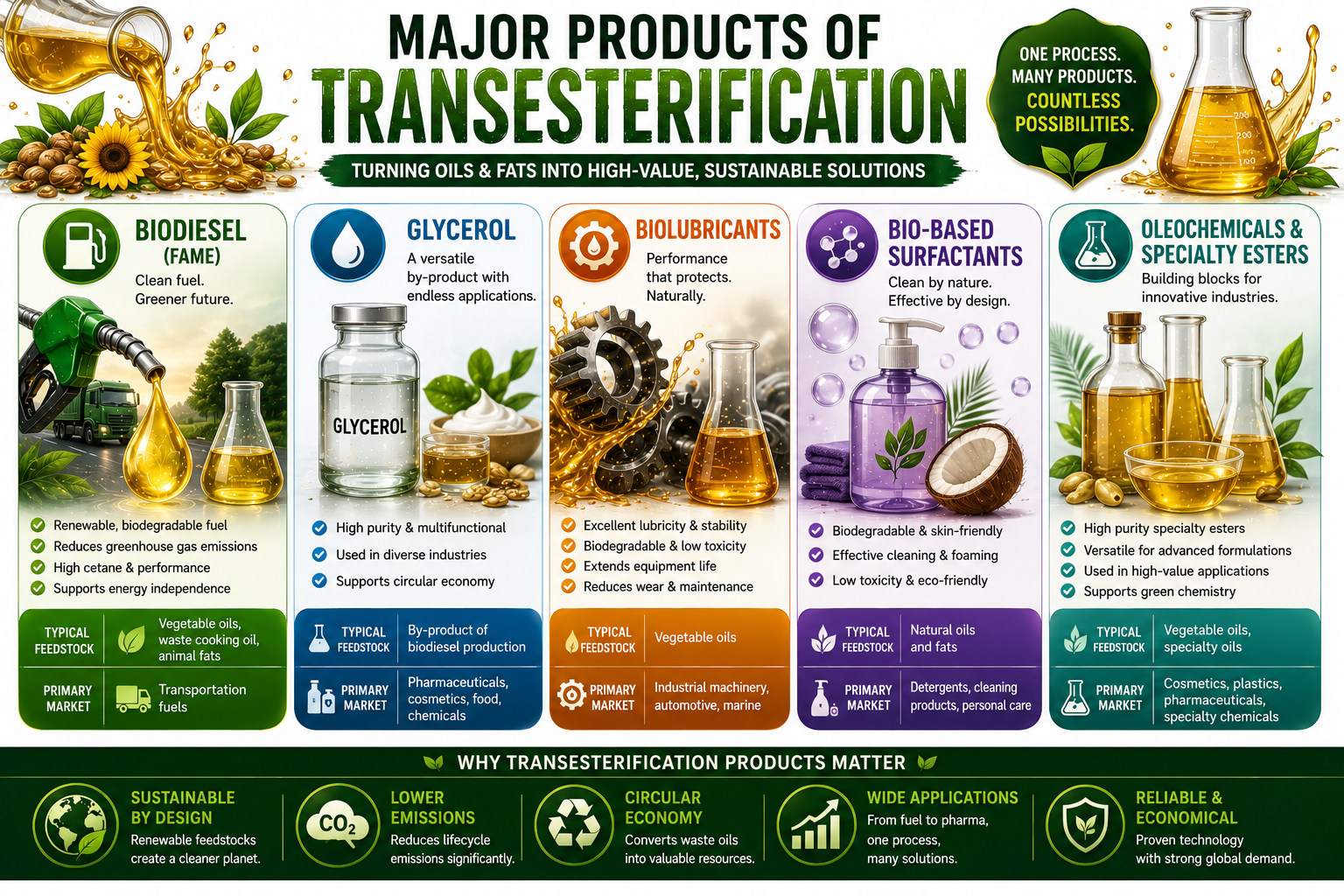
1. Biodiesel (Fatty Acid Methyl Esters – FAME)
Feedstock: Vegetable oils, used cooking oil, animal fats, non-edible oils
Process: Triglycerides + Methanol → Transesterification → Fatty Acid Methyl Esters (FAME)
Biodiesel is the primary product of transesterification and the world’s most widely produced renewable diesel substitute. It possesses combustion characteristics similar to petroleum diesel and can be used in blends (B5, B20) or as neat biodiesel (B100), depending on engine specifications and national fuel standards.
Key Applications: Passenger vehicles, buses, trucks, agricultural machinery, generators
2. Glycerol (Glycerin)
Feedstock: By-product of biodiesel production
Process: Transesterification → Phase Separation → Glycerol Purification
Approximately 10% of the total product stream generated during transesterification is crude glycerol. After purification, glycerol becomes a high-value industrial chemical used across multiple sectors.
Key Applications: Pharmaceuticals, cosmetics, food additives, personal care products, resins, polymers
3. Fatty Acid Esters for Lubricants
Feedstock: Vegetable oils and specialty fatty acids
Process: Transesterification → Ester Modification → Biolubricants
Certain fatty acid esters produced through transesterification are further modified to manufacture biodegradable lubricants with excellent lubricity and low environmental impact.
Key Applications: Hydraulic fluids, transformer oils, marine lubricants, industrial machinery
4. Bio-Based Surfactants and Detergent Ingredients
Feedstock: Natural oils and fats
Process: Transesterification → Ester Derivatives → Surfactant Production
Fatty acid methyl and ethyl esters serve as important intermediates in the production of biodegradable surfactants and detergent ingredients. These renewable alternatives are increasingly replacing petroleum-derived surfactants in household and industrial cleaning products.
Key Applications: Detergents, soaps, industrial cleaners, emulsifiers
5. Oleochemicals and Specialty Esters
Feedstock: Vegetable oils, animal fats, specialty plant oils
Process: Transesterification → Fatty Acid Ester Production → Chemical Conversion
Transesterification is widely used in the oleochemical industry to manufacture specialty esters that serve as intermediates for numerous high-value products.
Examples of Products:
- Fatty Acid Methyl Esters (FAME)
- Fatty Acid Ethyl Esters (FAEE)
- Emollients
- Plasticizers
- Cosmetic esters
Key Applications: Cosmetics, pharmaceuticals, coatings, plastics, specialty chemicals
Future Growth Drivers
The future of transesterification will depend not only on technological improvements but also on the expanding demand for sustainable transportation fuels and the availability of low-cost renewable feedstocks.
- Growth in biodiesel blending mandates will continue to drive global demand for biodiesel production.
- Expansion of waste cooking oil, animal fats, and non-edible oil supply chains will improve feedstock sustainability and reduce production costs.
- Decarbonization of heavy transportation will sustain demand for renewable liquid fuels that are compatible with existing diesel infrastructure.
- Advances in catalyst technologies and continuous processing will improve efficiency while lowering operating costs.
- Greater integration within biorefineries will increase the value recovered from biodiesel, glycerol, and other co-products.
- Supportive government policies, carbon reduction targets, and renewable fuel incentives will remain critical for accelerating commercial deployment.